TAMWAVE 3: Basic Results of Pile Capacity Analysis

TAMWAVE 2: Modifying the Soil Properties

Don Warrington's avatarvulcanhammer.net

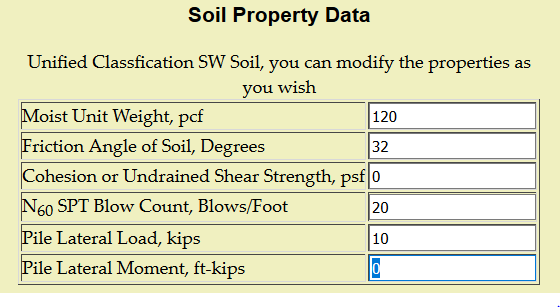
With the first step out of the way, we can proceed to the second: allowing the user to modify the properties of the soil.ย  This option must be used with care since it is easily possible to put together a set of soil properties that is physically unrealistic if not impossible.

Also, if you have chosen a sand or clay, you have chosen the methodology you will use.ย  Adding cohesion to a sand or gravel, for example, will have no effect on the subsequent performance of the model.

Finally, depending upon the choice of a free or fixed head, you are given the option of entering lateral loads and/or moments for the pile head.ย  In this case we have opted to add a lateral load of 10 kips to the pile and no moment.ย  The default is zero for both load and moment; this will produce some coefficients butโ€ฆ

View original post 5 more words

TAMWAVE 1: Entering Basic Soil and Pile Properties

Don Warrington's avatarvulcanhammer.net

With a few preliminaries out of the way, we can proceed to discuss the new TAMWAVE routine, which can be found here.

What is TAMWAVE?

TAMWAVE stands for Texas A&M Wave Equation.ย  The TTI wave equation was developed at Texas A&M in the late 1960โ€™s and early 1970โ€™s, and was a successor to Smithโ€™s original wave equation program.ย  In reality this is more than a wave equation program; it is a driven pile analyser which, in addition to the wave equation program, analyses the static performance of a driven pile for both axial and lateral loads.ย  It is not intended to be used on actual projects, but as an educational tool for students.ย  Most of the software in current use is expensive, and predecessors such as SPILE, WEAP87 or COM624 are hard to use (theyโ€™re DOS programs) or methodological obsolescence issues.ย  (With WEAP87, there are not asโ€ฆ

View original post 832 more words

Relating Hyperbolic and Elasto-Plastic Soil Stress-Strain Models

It is routine in soil mechanics to attempt to use continuum mechanics/theory of elasticity methods to analyse the stresses and strains/deflections in soil. We always do this with the caveat that soils are really not linear in their response to stress, be that stress axial, shear or a combination of the two. In the courseย [โ€ฆ] … Continue reading Relating Hyperbolic and Elasto-Plastic Soil Stress-Strain Models

TAMWAVE: Pile Toe Resistance, and Some More on Pile Shaft Resistance โ€” vulcanhammer.net

With this post we begin to discuss our โ€œotherโ€ project: the TAMWAVE project. Itโ€™s been around a long time but is now being revised. The concept is to afford students a method of getting acquainted with several aspects of computer-aided driven pile design, including the following: Estimating axial capacity of the pile; Estimating the axialย [โ€ฆ] … Continue reading TAMWAVE: Pile Toe Resistance, and Some More on Pile Shaft Resistance โ€” vulcanhammer.net

We’ve Moved At Last, But Took the Online Pile Routines Somewhere Else

After a summer of eclipses and hurricanes, we're pleased to announce that vulcanhammer.info has finally moved to its new platform as of yesterday.  Click here and check out what we have to offer.  Most of the content has gone with the site; we've added many photographs and used the transition to correct many of the … Continue reading We’ve Moved At Last, But Took the Online Pile Routines Somewhere Else

The Best Way to Celebrate Your 120th Birthday is With a New Slide Bar Part

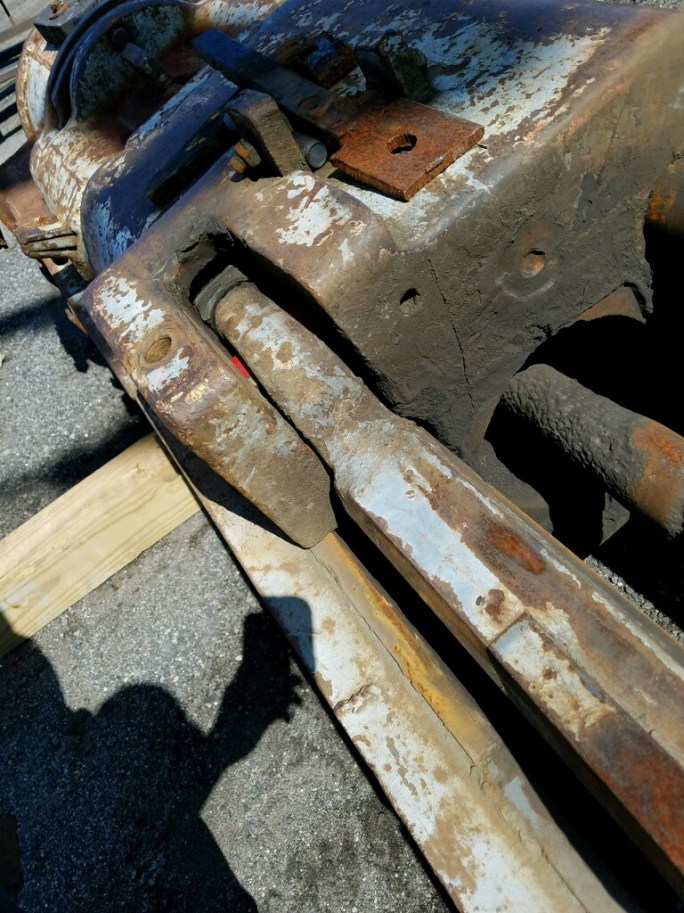
On our Engineering at Vulcan page, we posted this general arrangement of the Vulcan #2 dated 1887. Little did we suspect that we'd need that drawing, but then these photos from Crofton Diving of Portsmouth, VA, arrived: The hammer in question is Vulcan S/N 116, originally sold to the Florida East Coat Railroad (not far … Continue reading The Best Way to Celebrate Your 120th Birthday is With a New Slide Bar Part

Drivability of Vulcan Hammers and Other Pile Driving Equipment

This section of vulcanhammer.info is about the drivability and performance of pile driving equipment in general and Vulcan hammers in particular. It's divided into several sections: Dynamic formulae: the original method of relating hammer performance to pile capacity and resistance Before Wellington and ENR: Early Dynamic Formulae, and Sanders' Formula Putting Dynamic Formulae to the Test: the … Continue reading Drivability of Vulcan Hammers and Other Pile Driving Equipment

Papers and Documents on Pile Driving and Driven Piles

The papers and monographs below are of general interest. We also offer the following topical pages as well: Pile Driving in Practice Pile-Soil Interaction (including static methods of pile capacity analysis) Programs and spreadsheet for pile capacity analysis Detailed information on pile dynamics and the wave equation is here. Allowable Stresses for the Upside-Down Timber … Continue reading Papers and Documents on Pile Driving and Driven Piles

Pile Soil Interaction (including Static Capacity Analysis of Piles, Axial and Lateral)

The Action of Soft Clay Along Friction Piles: Bay Mud Revisited Lymon C. Reese1983 Research at Berkeley more than three decades ago gave new insight into the behaviour of axially-loaded piles in clay. Numerous experiments and analytical studies performed since, many of which have been supported by the oil industry with respect to offshore platforms, … Continue reading Pile Soil Interaction (including Static Capacity Analysis of Piles, Axial and Lateral)