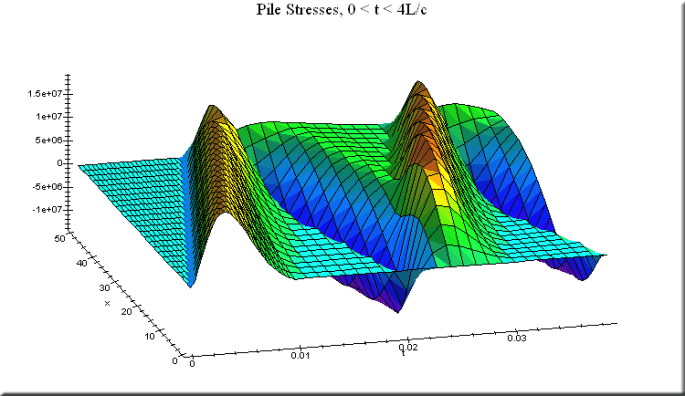
The work of both Isaacs and Glanville et.al. demonstrated two things: Wave propagation in piling was a real phenomenon; predicting it opened up the possibility of accurate prediction of pile stresses and resistance. The mathematical complexity of the problem--related to the complexity of the hammer-cushion-pile system, the existence of shaft friction (which, in theory, forced … Continue reading Smith’s Wave Equation Program–the first numerical method
Category: Drivability and Vulcan Hammers
Isaacs and Glanville: The Beginnings of the Wave Equation for Piles
The years after Wellington set forth the Engineering News Formula saw the general acceptance of dynamic formulae as a method of relating the performance of an impact hammer (drop or steam) with the bearing capacity of the pile. The technology of driven piles, however, was not standing still, and two factors in particular began to undermine … Continue reading Isaacs and Glanville: The Beginnings of the Wave Equation for Piles
Introduction to Wave Mechanics in Piling
Introduction Wave propagation in impact driven piles has long been recognised, and is now used routinely to predict, modify and verify driving stresses and ultimate capacity of driven piles. Unfortunately, the numerical methods that were adopted early in the actualisation of the theory have turned the whole subject into something of a "black box" affair … Continue reading Introduction to Wave Mechanics in Piling
Vulcan and Dynamic Formulae
For many years the main method of drivability/resistance correlation were the dynamic formulae. It's interesting that the Engineering News formula and the Vulcan #1 hammer came into the world at about the same time. Vulcan featured the Engineering News formula in its literature as early as 1906, and this continued until the 1970's. We explore … Continue reading Vulcan and Dynamic Formulae
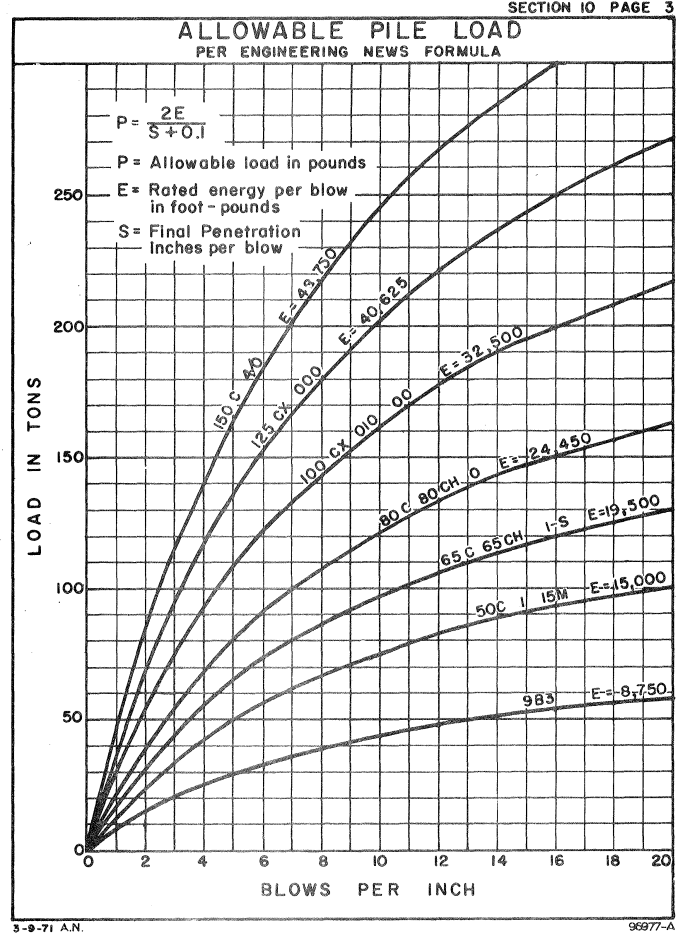
The Engineering News Formula, and Its Treatment in Early Vulcan Literature
The results from the Martello Castle/Proctorsville project and other works demonstrated the weaknesses of the dynamic formulae. Although other formulas would be devised, the 29 December 1888 edition of Engineering News would change everything. Arthur Mellen Wellington, another prominent American civil engineer, published a formula that would dominate pile dynamics (in the US, at least) … Continue reading The Engineering News Formula, and Its Treatment in Early Vulcan Literature
Before Wellington and ENR: Early Dynamic Formulae, and Sanders’ Formula
Most treatments of dynamic formulae begin with the Engineering News Formula, proposed by A.M. Wellington in 1888 (about the time the first Vulcan #2 was produced.) But activity in this field had been going on for a long time before that. As Robert Chellis noted in his book Pile Foundations, the first pile driving formula … Continue reading Before Wellington and ENR: Early Dynamic Formulae, and Sanders’ Formula
Vulcan Onshore Tip #7: 11 Rules for Pile Driving
The Name of the Game -- Heavier Ram - Shorter Stroke Concrete piles cracking while driving in either soft silt or very hard ground? The solution is the same for both problems: Use a thicker cushion block and a hammer with a heavier ram and shorter stroke. The solution and others to related problems, comes … Continue reading Vulcan Onshore Tip #7: 11 Rules for Pile Driving