
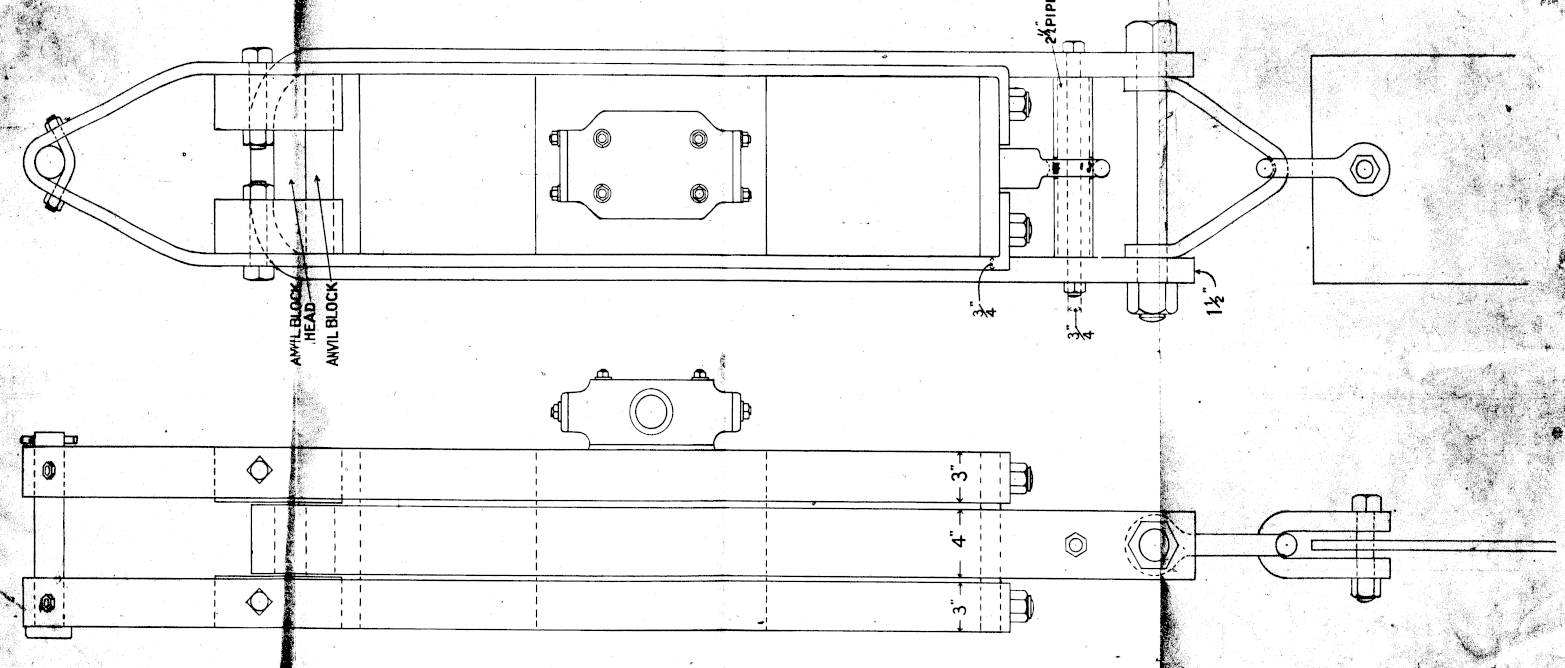
Vulcan sometimes liked to think that it was the “only game in town” when it came to pile drivers. But we knew it wasn’t true. Before diesel and vibratory hammers became common and air/steam hammers “ruled the roost” Vulcan’s main competitor was McKiernan-Terry (MKT.) Based in northern New Jersey (its last facility there was in Dover) it posed the greatest threat to Vulcan for a long time.
We have a couple of MKT catalogues for download:
- Double- and Single-Acting Pile Hammers and Pile Hammer Rigs (MKT Bulletin 60.)
- Sand Drain Hammers (MKT Bulletin 71.)
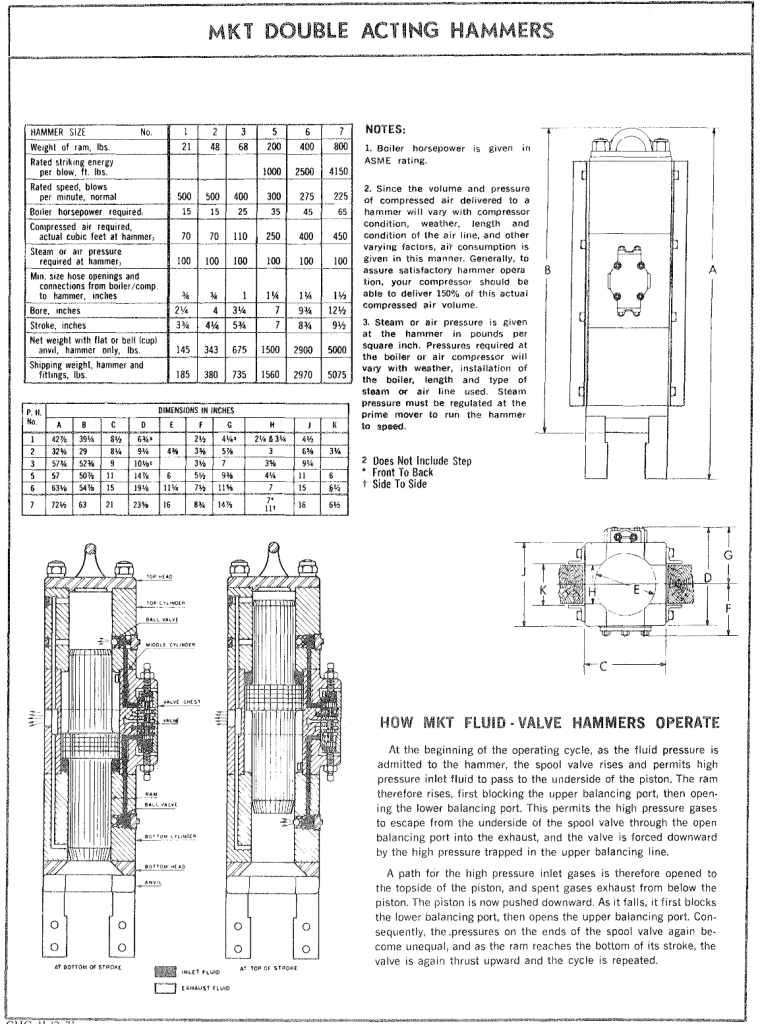
The double-acting hammers–both the numbered and the “B” series–were Vulcan’s toughest competitor in that field. They were versatile, especially in driving sheet piles before the advent of vibratory hammers (and continue to be to this day.) Sometimes, however, it didn’t work out for the MKT, as shown in the post When the Vulcan #2 Beat the MKT 9B2. The basic information on these hammers is below.

The single-acting hammers were not quite as formidable. The double acting hammers benefited from the closed design (especially when bearing capacity was not an issue, as is the case with sheet piles.) Closed hammers became a liability when inspectors and engineers wanted to see the ram move with a specific stroke, the source of energy for single-acting hammers. Vulcan’s open design was also an advantage for repair purposes, in an era when many contractors worked on their own hammers.
A large drawback, however, was the fact that MKT hammers–double- and single-acting alike–were cushionless. With steel piles this was an advantage, if the blow counts could be kept reasonable (and in many cases they could not.) With wood and especially concrete piles, this became a liability. This may explain why Raymond–nearly a neighbour to MKT–opted to use the Vulcan design as a basis of their own hammers. The one place where a cushionless configuration had potential as a significant advantage was offshore, where the high peak velocities became high peak forces as the stress wave moved down the pile. Here the durability issue came to the front; it wasn’t until the 1980’s when IHC and Menck designed hammers durable enough (and expensive enough) to withstand cushionless driving on a practical basis.
Vulcan had no intention of taking any chances, however, with the S- series hammers; below is a competitive comparison Vulcan prepared for these hammers in the 1960’s.

MKT tried other types of air/steam equipment, including the C series (which Vulcan manufactured a modified version as the Airmizer hammer) and the E type extractors, which were similar to Vulcan’s. MKT had an additional trick up its sleeve: one could take the smaller double-acting hammers, upend them, put a sling on them, and use them as an extractor (as one can see at the top of the post in a Vulcan drawing.) They also marketed an onshore version of the Menck hammer, but this was of limited success.
MKT was out front with the new technologies in the 1960’s, developing a fabricated diesel hammer and a hydraulic vibratory hammer, the latter being the first to be built. From the start the diesel hammer had to compete with the Delmags, not an easy proposition (as Vulcan found out the hard way in the 1980’s.) In some ways the vibratory design–a departure from earlier machines such as those made in Japan, the USSR and France–was too early and found itself at a disadvantage when International Construction Equipment produced–and directly marketed–its hammers in the 1970’s.
MKT also suffered from the conglomerate craze of the late 1960’s and 1970’s, becoming at one point part of Litton Industries. In the mid-1980’s it was sold to Mississippi Valley Equipment. It’s last president, G. Robert “Bob” Compton went on to become President and then Executive Director of the Deep Foundations Institute, and I was honoured to be his friend.
Today MKT is still a part of Mississippi Valley Equipment, but service for the air/steam hammers can be found, as is the case with Conmaco and Raymond hammers, at Vulcan Foundation Equipment.


2 thoughts on “McKiernan-Terry”