
For more of this book, click here.
Boreholes constructed in construction serve various purposes, diameters, and depths (listed below).
| Purpose | Diameter, mm | Maximum Depth, m |
| For cast-in-place piles | 500–1200 | 25 |
| Geotechnical | 100–300 | 30 |
| Freezing | 100–200 | 30 |
| Blasting | 200–250 | 20 |
| Water supply | 200–400 | 500 |
| Dewatering | 300–600 | 300 |
They are used for constructing cast-in-place piles, conducting geotechnical surveys, performing soil-freezing operations, placing explosive charges when executing blasting operations. Water supply wells, which are constructed for water supply purposes or to solve the problem of dewatering foundation pits or mine workings, constitute a special area of drilling operations in construction.
During borehole drilling, two main processes are performed:
- Destruction of rock or separation of a certain volume of rock from the mass;
- Transportation of the destroyed rock from the bottom of the hole to the surface.
When drilling geotechnical, freezing, and blasting boreholes, as well as boreholes for cast-in-place piles, characterized by shallow depth and simple design, both of these processes can be performed by vibratory means without using drilling rigs.
Water wells, characterized by significant depth and a fairly complex design, are constructed using percussion-cable and rotary rigs. However, even in this case, if vibration operations are included in the scope of work, a number of operations can be intensified, and the production of drilling operations as a whole can be significantly improved.
When drilling boreholes up to 30 m deep in geological conditions characterized by alternating non-cohesive and cohesive plastic soils, the use of vibratory technology ensures the execution of the entire cycle of operations for well construction and allows solving the following tasks:
- Simplifying the production of operations by eliminating the use of bulky and expensive rotary or percussion-cable drilling rigs;
- Shortening the well construction cycle by reducing both the duration of preparatory work and increasing the penetration rate;
- Ensuring, if necessary, the securing of borehole walls with casing pipes;
- Reducing the range of machinery used, since the vibratory machine used for penetration can also drive and extract casing pipes;
- Complete extraction of casing pipes from the ground during the liquidation of wells whose design includes such pipes.
As for water wells, the use of vibratory technology makes it possible to increase the technical and economic indicators of various types of work related to the construction and operation of this type of structure. Figure 78 schematically shows operations over the entire period of a water well’s existence.
An analysis of the state of technical and economic indicators of individual types of work at the stages of construction, development, operation, and liquidation made it possible to determine the main tasks that can be solved by improving vibratory machinery, and the technology of water well construction and repair.
During well construction:
- Increase the drilling speed in hard and cohesive soils;
- Reduce the metal consumption of well structures constructed by the percussion-cable method;
- Increase the efficiency of work to free stuck drilling tools.
During well development:
- Shorten well development time by intensifying the removal of clay particles from the pores of the bottomhole zone of the aquifer;
- Ensure natural permeability of the aquifer in the bottomhole zone and the formation of a sand-and-gravel filter with high filtration parameters to increase the durability and reliability of well operations as water supply sources.
During well operation:
- Ensure high-quality restoration of permeability for clogged filters and the near-bottomhole zone of the aquifer using methods that allow for repeated application without harmful impact on the structural elements of the well;
- Increase the time between well repairs and extend their durability;
- Reduce labor costs and increase the productivity of repair work.
During well liquidation:
- Ensure the technical capability for highly productive extraction of casing pipes from abandoned wells that cannot be repaired (the use of standard static methods offers low productivity and, in the vast majority of cases, leads to the breakage of casing pipes; therefore, at the present time, during well liquidation, plugging is usually carried out without extracting the casing pipes).
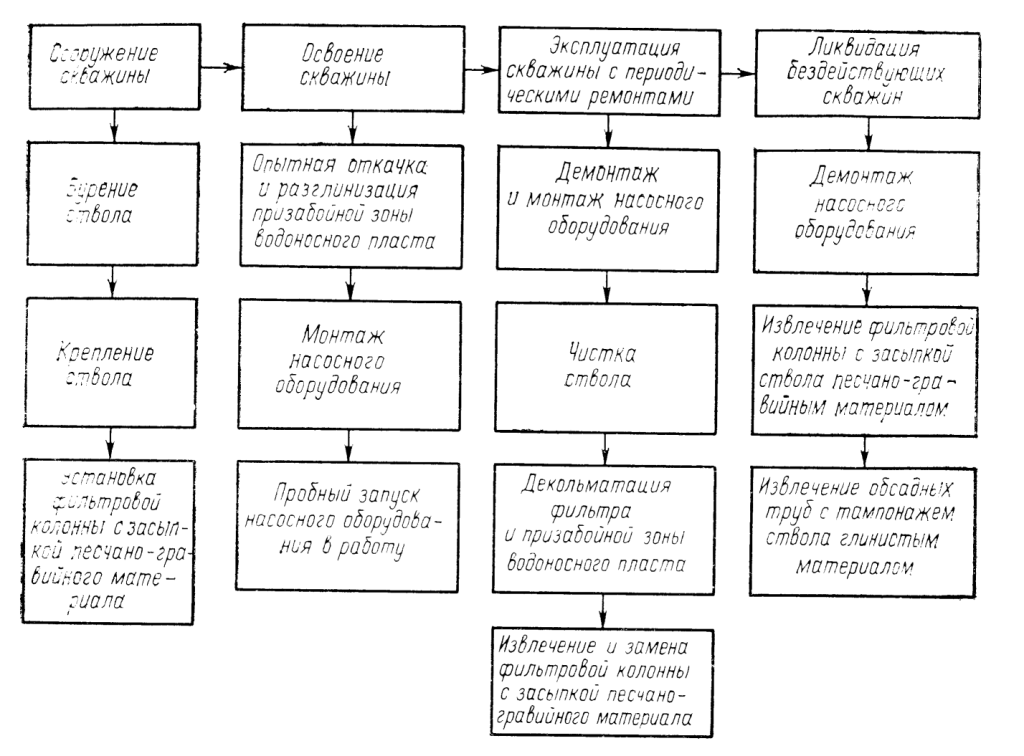
[Column 1: Well Construction]
- Well construction
- Borehole drilling
- Borehole casing
- Installation of filters, caverns, and packing of sand-gravel material
[Column 2: Well Development]
- Well development
- Experimental pumping and clay removal from the near-bottomhole zone of the aquifer
- Installation of pumping equipment
- Trial run of the pumping equipment into operation
[Column 3: Operation with Periodic Repairs]
- Well operation with periodic repairs
- Dismantling and installation of pumping equipment
- Cleaning of the branch/drain
- Declogging of the filter and the near-bottomhole zone of the aquifer
- Extraction and replacement of the filter string with packing of sand-gravel material
[Column 4: Closing of Inactive Wells]
- Closing of inactive wells
- Cementing of above-filter equipment
- Extraction of the filter string with cleaning of the borehole from sand-gravel material
- Extraction of casing pipes with plugging of the borehole with clay material
The solution to these listed problems boils down to the need to intensify the following processes:
- Overcoming friction forces (bonding) between the surface of the pipe (soil sampler, drilling tool) and the soil;
- Destruction and development of hard and cohesive rocks; removal of clay particles from the pores of water-bearing rocks and destruction of structural bonds between these particles;
- Dissolution by reagents of chemical compounds that clog the filter and the near-bottom hole zone of the aquifer;
- Fractional placement of packing material during the formation of a sand-gravel filter in the zone of the aquifer;
- Lifting water from the well with suspended particles and injecting chemical reagents into the filter zone.
The possibility of increasing the efficiency of these processes using the vibrational method is explained by the following main factors:
- Under the action of vibration, friction forces between the pipe surface and the soil, as well as between the soil particles themselves, decrease sharply; this factor is used when solving problems of driving and extracting soil samplers, probes, or casing pipes, driving filter strings with a driven expander, extracting damaged filter strings, and also eliminating tool seizures in the borehole by vibrational or impact-vibrational mechanisms;
- The dynamic strength of hard rocks is several times lower than static strength; under cyclic impact-vibrational loading, fatigue properties of hard rocks manifest themselves, and the efficiency of their destruction increases; these circumstances form the basis for solving the problem of developing hard rock drilling tools utilizing impact-vibrational heads;
- When a body vibrates in a liquid, it becomes a source of hydrodynamic pressure; this effect is used when solving problems of declogging wells by the vibratory hydrodynamic method, and can also be applied when forming sand-gravel backfills with high filtration qualities;
- Vibrating a pipe accelerates the dissolution reaction of chemical substances, destroys the structural bonds of chemical compounds, improves mass transfer conditions at the reagent-substance contact interface; these factors form the basis for solving the problem of restoring well productivity clogged with deposits of chemical origin, using a combined vibratory-reagent method with various tool designs;
- When a pipe equipped with a check valve vibrates in a liquid, transportation of the liquid is achieved; this factor is used when solving the problem of lifting water from a well during its development or repair, and for injecting chemical reagents behind the filter contour using a vibrational pump.
The first experiments on using vibration in drilling work were carried out in 1950 (D. D. Barkan, 1959). They concerned the drilling of geotechnical boreholes. Subsequently, methods of vibrational technology were developed not only for this type of borehole, but also for all others presented above. In this work, active participation was taken by NIIOSP, VNIIGS, Promstroiproekt, Lengiprotrans, LGI, Gidroproekt, Mosgorgeotrest, PNIIIS, VNIIStroidormash, Glavtonnelmetrostroi, and a number of other organizations. The result of work carried out by these organizations in various years of scientific research and experimental design developments were specialized vibrational and percussion-vibrational machines, and in a number of cases, completed self-propelled units for performing drilling operations for various construction purposes.
Substantial practical importance and sufficient production testing are held by the developments of VNIIGS on the creation of vibro-grab buckets and vibrational technology for installing cast-in-place piles (see Chapter IV), developments of PNIIIS and Gidroproekt on the creation of self-propelled units equipped with a percussion-vibrational device for drilling geotechnical boreholes, as well as complex developments of VNIIGS on vibrational machinery and technologies intended for use in various operations during drilling, completion, and repair of water wells.


One thought on “General Information On The Use Of The Vibratory Method In Drilling Operations”