
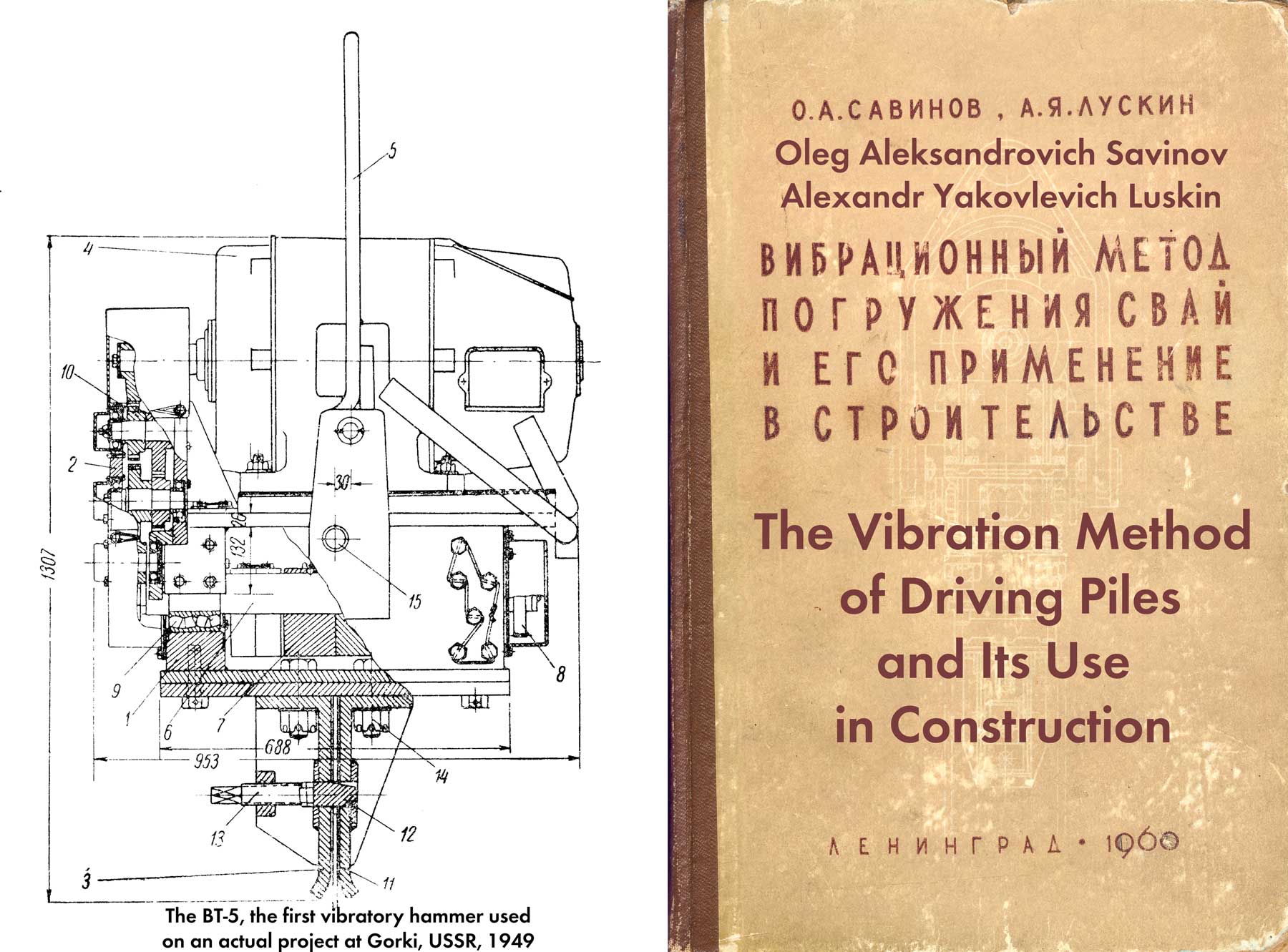
Citation: O. A. Savinov and A. Ya. Luskin, The Vibration Method of Driving Piles and Its Use in Construction [in Russian], Gosstroiizdat (1960).
Scientific editor – Dr. tech. Sciences Prof. D. D. Barkan.
In a form accessible to the engineer, this book outlines the basics of theory, technology and experience production application of the vibration method for sheet piling, piles and pipes. Included are recommendations for the selection of optimal parameters for vibratory hammers of various types and purposes. The most rational schemes devices and existing structures of these mechanisms are considered. Based on experience, economic advantages of different production methods are shown.
The book is intended for civil engineers, designers and employees of research institutions associated with the application of vibromethod in industrial and civil construction.
Abstract of the Book
- Some Lessons from “Savinov and Luskin”
- Introduction
- Chapter I General information
- § 1 Physical and Mechanical Features of the Phenomenon of Vibration Immersion
- § 2 Factors on which the speed and depth of immersion of a pile subjected to vibration depends
- § 3 Existing Proposals for the Theory of Vibratory Pile Driving
- § 4 Practical Methods for Selecting the Parameters of a Vibratory Pile Driver
- Chapter II Vibrating machines for driving sheet piles, piles and pipes
- Chapter III Manufacture of works on vibration immersion and extraction of metal sheet piles
- § 11 General information
- § 12 Performance of work on immersion of metal sheet piles using jib cranes
- § 13 Features of the Technology of Vibratory Immersion of Sheet Piling Using Piling Headframes
- § 14 Basic data of production experience and technical and economic indicators of vibration immersion of metal sheet piles
- § 15 Work on Vibratory Extraction of Metal Sheet Piles from the Ground
- Chapter IV Performance of work on vibration driving of piles and pipes
- § 16 Vibratory Driving of Light Piles
- § 17 Production Experience of Driving Heavy Reinforced Concrete Piles with Low-Frequency Longitudinal Vibratory Hammers
- § 18 About the Bearing Capacity of Piles Driven by Vibration
- § 19 Application of Low-Frequency Longitudinal Vibratory Hammers for Immersion of Hollow Piles and Shell Wells into the Ground
- § 20 Construction of concrete cast-in-place piles and sand piles-drains using the vibration method
- Chapter V Use of Piling Vibratory Drivers for Certain Other Types of Work
- § 21 Drilling Using Vibration of Deep Dewatering and Artesian Wells
- § 22 Use of Vibratory Hammers for Trenchless Pipe Laying
- § 23 Application of Vibratory Hammers for Soil Compaction
- § 24 Application of Vibratory Hammers in the Development of Frozen Soils
- § 25 Immersion of Thin Steel Pipes into the Ground
- Conclusion
- References
Editor’s Foreword
The years from the 1930’s through the 1960’s were fruitful ones in the advancement of geotechnical engineering. Many of the concepts, theoretical and empirical, which we still use today were developed during this era. The slowing of real progress in the years following are reflected in the fact that this document was able to be useful for the next half century (and still is, although it’s being updated.)
One of those advancements was the application of vibratory technology to soil compaction, drilling works and above all to driven piles. Much of this work took place in the Soviet Union. Although many consider the initial work on this subject to be D.D. Barkan’s “bombshell” paper at the 1957 Fourth International Conference of Soil Mechanics and Foundation Engineering, in reality this book is the first major summary on vibratory technology specifically applied to driven piles. In that respect it should stand with Smith’s 1960 paper on the wave equation (which came out at about the same time) as a seminal work in geotechnical engineering in general and driven piles in particular. (Another classic is D.D. Barkan’s Dynamics of Bases and Foundations, which is available here.)
The development of this technology, which was a broad program consisting of theoretical work, equipment design and application, is one that is seldom seen in this field, and as such is one of the great achievements in both geotechnical engineering and equipment design. It is our pleasure to bring this into view for geotechnical engineers and equipment people alike.
The organisation and translation of this work is similar to our previous effort in Vibro-Engineering and the Technology of Piling and Boring Work. We welcome any comments and suggestions that you might have.

 vulcanhammer.info
31 thoughts on “The Vibration Method of Driving Piles and Its Use in Construction”