
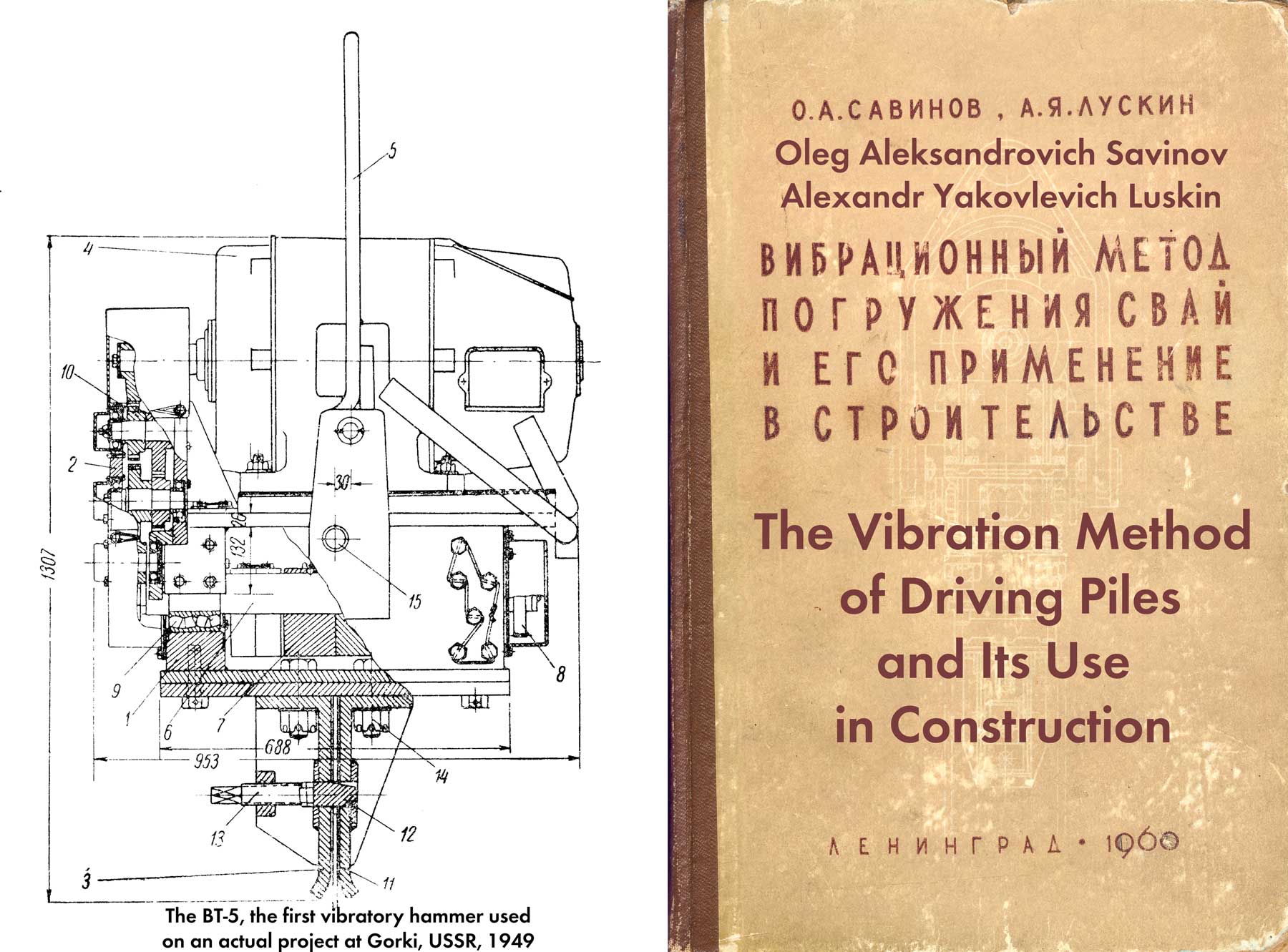
For the rest of the book, click here. Vibratory compaction has become an important technique for soil improvement. It is interesting that at the start vibratory pile drivers were used in the early development of the technology.
Vibratory pile drivers are increasingly used in industrial and hydraulic construction to compact soils.
Currently, there are two methods of vibration compaction of non-cohesive soils – deep and surface vibration. Special deep-seated vibrators are not yet mass-produced, and powerful surface vibrating machines are available only in some large specialized construction organizations. In this regard, in many cases, to compact cohesionless soils, it is advisable to use vibratory pile drivers, which are available in significant quantities in many construction organizations.
A vibratory pile driver used for surface compaction of soils is installed on a steel platform, to which it is rigidly fastened using simple devices. The design of the compaction plate, its size, the design of the head of the vibratory driver, the range of available materials, etc., may be different. In most cases, the simplest and most economical option is to construct a welded plate in the form of a steel sheet reinforced with ribs. The dimensions of the compaction plate can be selected according to Table. 48. The same table provides recommended values for the eccentric moment of vibratory hammers and data on the maximum power of the compacted layer.
| Vibratory Driver Model | Machine Weight, tons (without compaction plate) | Recommended Eccentric Moment, kg-cm | Compaction Plate Area, m2 | Maximum thickness of the compacted layer, m | ||
| Sandy Soils | Crushed Stone or Gravel | Sandy Soils | Crushed Stone or Gravel | |||
| VPP-1 with full load | 4.5 | 500 | < 5 | < 3 | 1.2 | 1.0 |
| VPP-1 without load, VPP-2 | 2.0-2.2 | 350 | 2-3 | 1.5-2.0 | 1.0 | 0.8 |
| V-102, V-104, V-108 | 1.8-2.0 | 1000 | 2-3 | 1.5-2.0 | 1.0 | 0.8 |
| VPP-4, VPP-4a without load | 1.2-1.5 | 220 | 1.5-2.0 | 1.2-1.5 | 0.8 | 0.5 |
| VPP-5 | 1.2 | 180 | 1-1.5 | 0.8-1.0 | 0.6 | 0.5 |
| VPM-2 with load | 0.63 | 60 | 0.8-1.0 | 0.5-0.8 | 0.5 | 0.4 |
| VPM-1 | 0.15 | 30 | 0.3-0.4 | 0.2-0.3 | 0.4 | 0.3 |
It should be noted that Table 48 was compiled on the basis of a relatively limited number of experiments, as a result of which the data contained in it are indicative. These data can only be clarified as a result of further experimental studies and production observations.
A vibratory driver with a plate moves over the area of the compacted soil layer attached to a tractor or using a crane. We will consider the peculiarities of the technology for compacting soils with vibratory hammers and indicators of technical and economic efficiency using examples taken from practice.
The Leningrad department of the Sevzapgidrostroy trust, with the participation of VNIIGS, used the VPP-2 vibratory hammer to compact the crushed stone embankment. The embankment was laid in a trench 2 m deep and 4 m wide in layers of 0.5-0.7 m; the crushed stone was large (3-12 cm). The welded compaction plate to the vibratory driver was constructed from scraps of Larssen IV type steel sheet pile (Fig. 118); The dimensions of the compaction plate were taken to be 0.8 x 1.8 m.
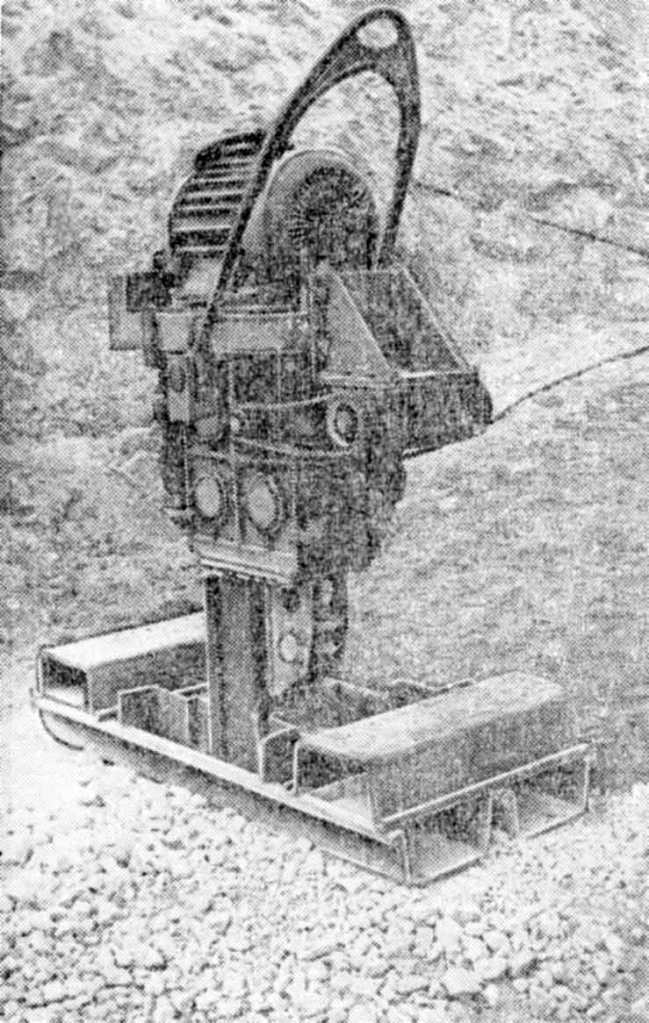
The vibrator, together with the plate, was freely installed on a layer of crushed stone and, when turned on, for 0.5-1.5 minutes. gave a settlement of up to 10-15 cm, providing a high degree of compaction of the embankment. The vibratory driver was lifted and moved by a 3-ton truck crane.
At Stalingradgidrostroy, vibratory pile drivers were used to compact sand in alluvial profile structures and in individual embankments [27].
In the first case, VPM-2 vibratory drivers were used, each of which was installed on a trough-shaped (with stiffening ribs) platform with plan dimensions of 1 x 1.5 m. The vibratory drivers were used in pairs, connected to the compaction platform using a special metal frame and mixed on a tow rope with a tractor ; The design of the vibratory driver also made it possible to work with the crane through a suspension.
As tests during the reclamation of the outport dam showed, the volumetric weight of sand increased from 1.53 to 1.57-1.58 t/m3 within a layer up to 0.8 m thick. The unit has a simple design and is reliable in operation. Vibratory compaction work can be carried out by an electrician and a tractor driver.
In the second case, when laying sand embankments, a VM-1 vibration machine was used, which consisted of a VPP-2 vibratory driver mounted on a compaction plate and an S-80 tractor (Fig. 119).
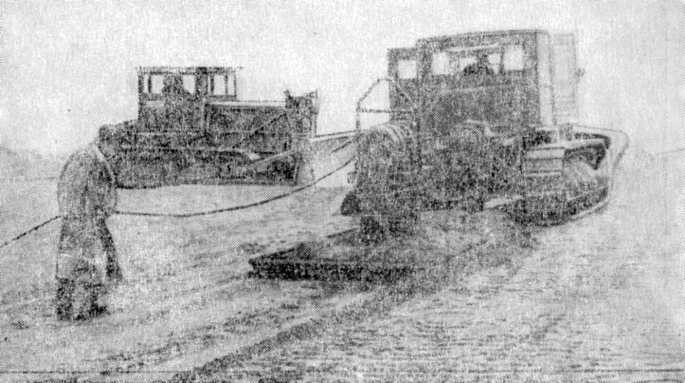
The vibrator was used without a head, the vibrator body was connected directly to the plate. The latter was constructed in the form of a trough made of sheet steel, reinforced with internal ribs. The towing device consisted of two tow bars, attached with hinges to the vibrator body, one in front and one in back. The dimensions of the base of the compacting plate were taken to be 2 x 2.5 m. The weight of the vibrator with the plate assembly turned out to be equal to 4.2 m. When compacting the soil, the vibrator unbalances were adjusted to a moment of 550 or 750 kg-cm.
During operation, it was found that at a speed of movement on loose soil of 0.5-0.7 m/sec, the traction force of the tractor is 2.5-2.8 tons. The machine compacts sandy soil well in layers of up to 1 m. Its average productivity reaches 1000 m3 per shift.
During testing, it was discovered that the rectangular shape of the steering wheel was not successful, since its corners interfere with the car’s turns. In addition, at the moment of turning, soil is raked up, which is poured behind the sides of the slab. If vibratory drivers are moved by a tractor, the corners of the compaction plate should be rounded and the sides raised to a height of 20-30 cm.
According to a similar scheme, the vibratory driver VPP-1 was used, equipped with an additional load of full weight (Fig. 120), when compacting the sandy foundation of a hydraulic structure being built by the Leningrad department of the Sevzapmoridrostroi trust. In this case, the compaction unit was towed by a bulldozer based on the DT-54 tractor, which carried out work to level the base before compaction. The thickness of the compacted layer at this site reached 1.5 m.
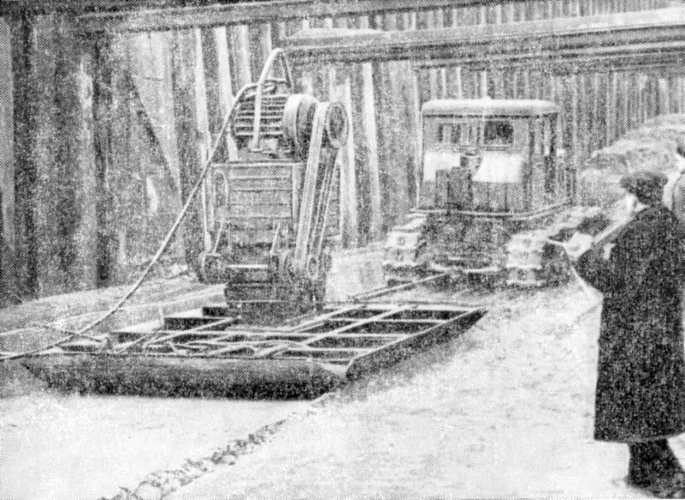
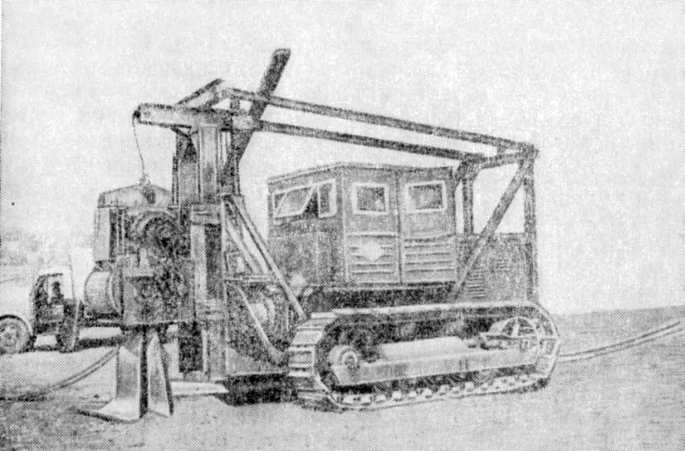
The experience of the Mechanization Department No. 19 is of interest. Trust No. 6 Glavmosstroy used the V-102 vibratory hammer to compact soil in road embankments. For these purposes, a self-propelled unit was designed (Fig. 121), consisting of a S-80 type tractor, a guide frame, a vibratory driver and a winch device for lifting and lowering it to the ground. The use of the unit gave positive results.
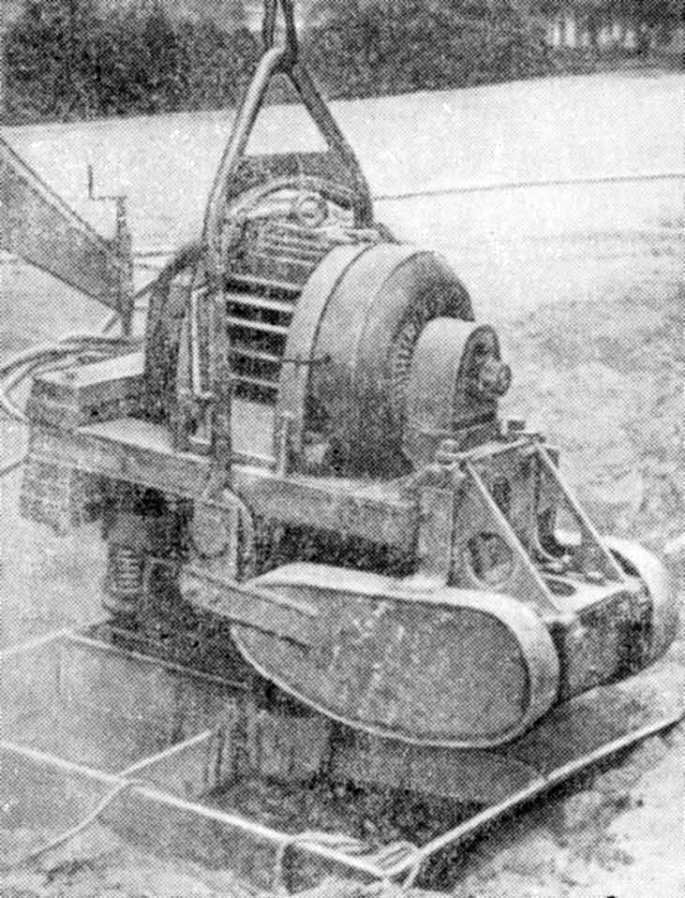
Recently, the Lenvodokanalstroy trust began using the VPP-5 vibratory driver (Fig. 122) to compact the soil in trenches when laying pipelines. Here the compaction plate is attached directly to the vibrator body using a piece of pipe and a flange. The vibratory driver is re-positioned using a 3-ton truck crane. The first experiments confirmed the high efficiency of the VPP-5 vibratory driver. Soil was poured into a trench by a bulldozer to its full depth in 1-2 minutes. With the operation of the vibrator, it was compacted to a depth of 30-40 cm. The productivity of the installation at the first stages of its operation was 120-150 m of trench per shift.
In all the cases considered, vibratory drivers were used to compact relatively large soil masses. There is every reason to believe that they can find application in compacting bulk soils by bayoneting and compaction in the cavities of pits. In bottlenecks in the backfills of structures, etc.


One thought on “Application of Vibratory Hammers for Soil Compaction”