Last October we featured the downloadable book Foundry Practice – Titov, Stepanov — Mir Books. Vulcan had a foundry for most of its existence, and relied heavily on sand cast (and other processes) products for its pile driving equipment. Now we offer this in print. You can order this book by clicking here. The book provides … Continue reading Foundry Practice Now in Print
A Short Handbook of Heat Treatment – Kamenichny
To Download this Book Click Here About the Book Ram point installation by cooling the point. Breakage of ram points is a major repair job in a Vulcan hammer (caused, in some cases, by use of wire rope biscuit as you see above.) Getting the "stump" of the point out was half the battle; click … Continue reading A Short Handbook of Heat Treatment – Kamenichny
The Dymo Embossing Labeller: A Vulcan Office Technology
In a company that maintained some kind of office for more than a century, Vulcan used many office technology that would be considered "legacy" today. In this case we'll consider one: the Dymo Embossing Labeller, in this case a Mark VI (M-6.) https://youtu.be/pZ0Gr8IZrAI It's shown in the context of the Fluid Mechanics Laboratory at UTC, … Continue reading The Dymo Embossing Labeller: A Vulcan Office Technology
Vector Statics and “Old Coot” Statics: An Example
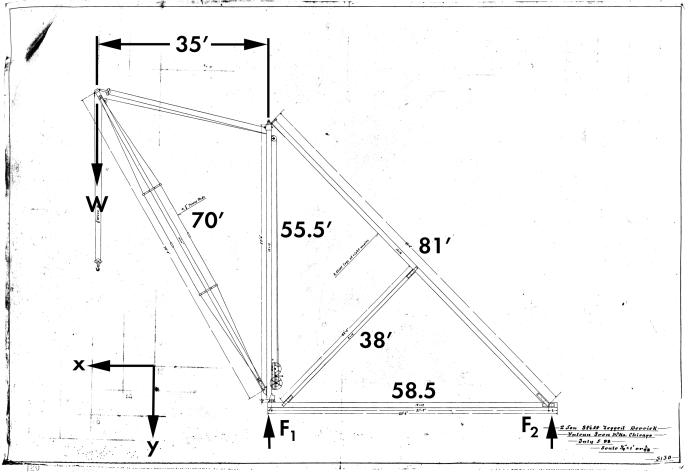
One thing that I bring up over and over again in my Soil Mechanics and Foundations courses is "static equilibrium," the summation of forces and moments for a given foundation. That's a good thing, because civil engineers are deeply disturbed when what they design moves and generally freak out when that happens. However, the usual … Continue reading Vector Statics and “Old Coot” Statics: An Example
Shortages and Supply Chains, Then and Now
Proud of a job well done: Jesse Perry (left) and Norris Tremmier stand in front of a 3100 hammer they have just completed assembling in a customer's own yard. The 3100 hammer was the last 3' stroke hammer Vulcan produced for the offshore market; compared to the 560 with the same energy, it was heavy … Continue reading Shortages and Supply Chains, Then and Now
Setting Column Keys in Cylinder and Base
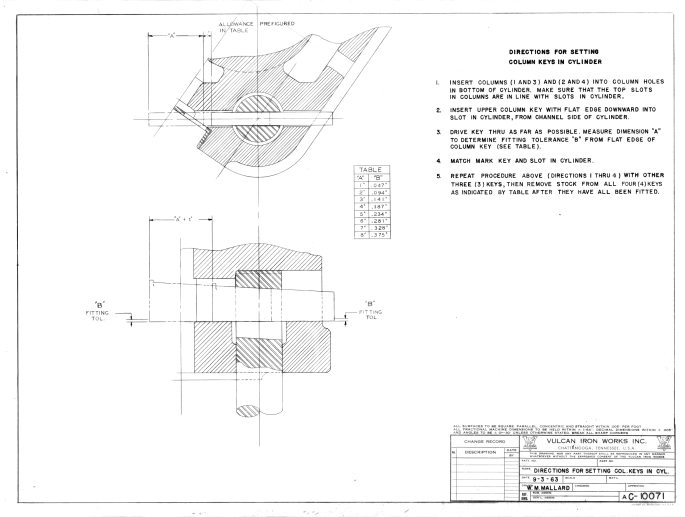
I would think that most Vulcan hammers in operation today are held together with cables. For those that aren't, here is Vulcan's procedure to set cylinder (above) and base (below) column keys, from 1963.
Foundry Practice – Titov, Stepanov
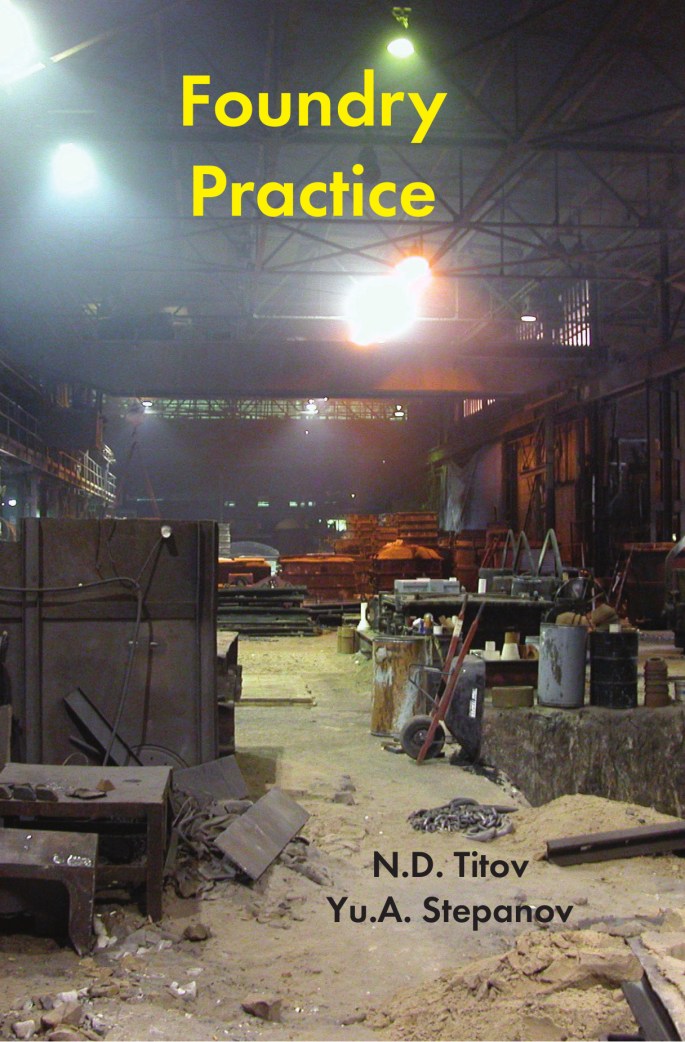
This book is available in print; click here to order About the Book The book is based on the lectures read to the students of machine- building secondary schools and also on the foundry practice course included in the curriculum of the Bauman Higher Technical School of Moscow. The book opens with a detailed description … Continue reading Foundry Practice – Titov, Stepanov
Getting the Point: Vulcan and Pile Shoes
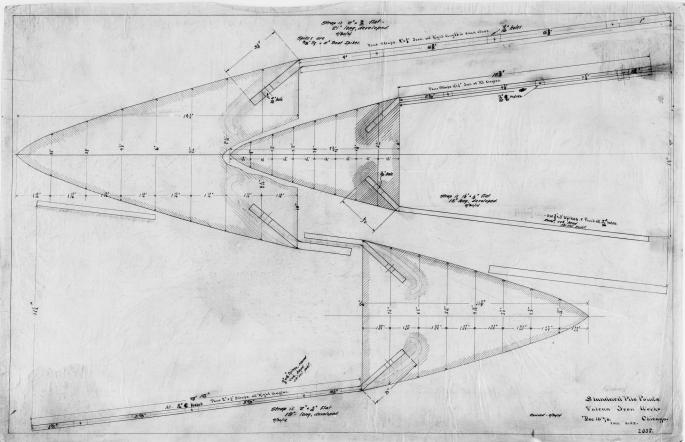
In some ways Vulcan came into the pile hammer business as a "one-stop shop." One of those stops was pile points. The first drawing produced of these was in 1896; the first documented appearance of these accessories in the catalogue was in 1909. As the drawings below show, evidence of them persists until the 1950's.
Coulomb and Rankine Earth Pressure Coefficients for Vertical Walls
Virtually all sheet pile walls are vertical; thus, it is not necessary to worry about the wall angle when considering lateral earth pressure coefficients for these walls. This means that equations for vertical walls and vertical walls with level backfills are all that is left. First, a complete chart, showing the nomenclature, from NAVFAC DM … Continue reading Coulomb and Rankine Earth Pressure Coefficients for Vertical Walls
Sheet Pile Templates
Before the advent of CAD, Vulcan used outline, full scale drawings or actual sheeting sections to lay out sheet pile caps in full size. The drawing board(s) in Chattanooga. On the wall are sheet pile sections, cut from actual sheet piling and used to lay out sheet pile caps. In front of the sheet piling … Continue reading Sheet Pile Templates