Welcome to vulcanhammer.info, the site about Vulcan Iron Works, which manufactured the durable air/steam line of pile driving equipment for more than a century. Many of its products are still in service today, providing reliable performance all over the world. There’s a lot here, use the search box below if you’re having trouble finding something. Also look at the end of an article, there are helpful links to more information with every post.
An Industry Gets Restless: Terzaghi’s 1929 Paper on Dynamic Formulae and the Response
Goodrich’s 1908 study on dynamic formulae was interesting but not as informative as one would like and not as impactful as he might have hoped. Wellington’s Engineering News Formula continued to dominate the scene (in the U.S., at least) and other formulae were coming in and out of vogue here and elsewhere. Goodrich had restricted himself to timber pile driven directly by drop hammers, and both piles and hammers were already changing rapidly. By the 1920’s the problems with the dynamic formulae were unresolved, something that Vulcan recognised all too well.
In the history of pile dynamics the ASCE document that gets the most attention (after Smith’s seminal one) is the study the Society commissioned in 1930, which lumbered through the decade and finally came out with its recommendations in 1941. The conclusions of that commission and the explosive response it received is documented in A Sea Fight in a Fog: Revisiting the ASCE Controversy about Dynamic Formulae. But even before that–or perhaps the inspiration of the appointment of the commission in the first place–Karl Terzaghi presented a paper entitled “The Science of Foundations–Its Present and Future” to the Structural Division on 20 January 1927. The response that ended up in the comments to the paper–which was finally published in 1929–exceeded the length of Terzaghi’s own monograph and revealed a great deal of discontent with the state of pile dynamics at the time as embodied in the dynamic formulae in general and the Engineering News formula in particular.
Terzaghi’s stated objective was to address the following shortcomings in foundation design and verification:
The principal shortcomings were found to be: First, the practice of selecting the admissible soil pressure regardless of the area covered by the individual foundation and irrespective of the maximum differential settlement that the superstructure can stand without injury; second, the practice of computing the bearing capacity of the piles by the Engineering News formula regardless of the character of the soil; and, third, the practice of considering the bearing power of the individual piles as a sufficient guaranty that the bearing capacity of the entire foundation will be adequate.
It’s interesting to note that most of this was touched upon in Putting Dynamic Formulae to the Test: the Proctorsville Fort Project, which also branched out into shallow foundation issues. We’ll restrict ourselves to the dynamic formula issue, and Terzaghi’s overview of that is as follows:
Concerning the pile-driving formuluas, the writer presenta physical arguments why, for certain soils, no pile-driving formula can possibly furnish reliable information concerning the bearing capacity of the tested pile. For those soils for which the pile-driving formulas can be used to advantage, the Engineering News formula is found to furnish values which are by far too small, provided a drop-hammer is used and the penetretion per blow amounts to less than 1/2 in.
When he gets to the topic of pile foundations, he starts with a formula based on the “theory of semi-elastic impact” which is also a basis for Goodrich’s more extensive discussion on the subject. He shows that, depending how you condense the theory, you can end up with the Engineering News formula. He then makes the following observations:
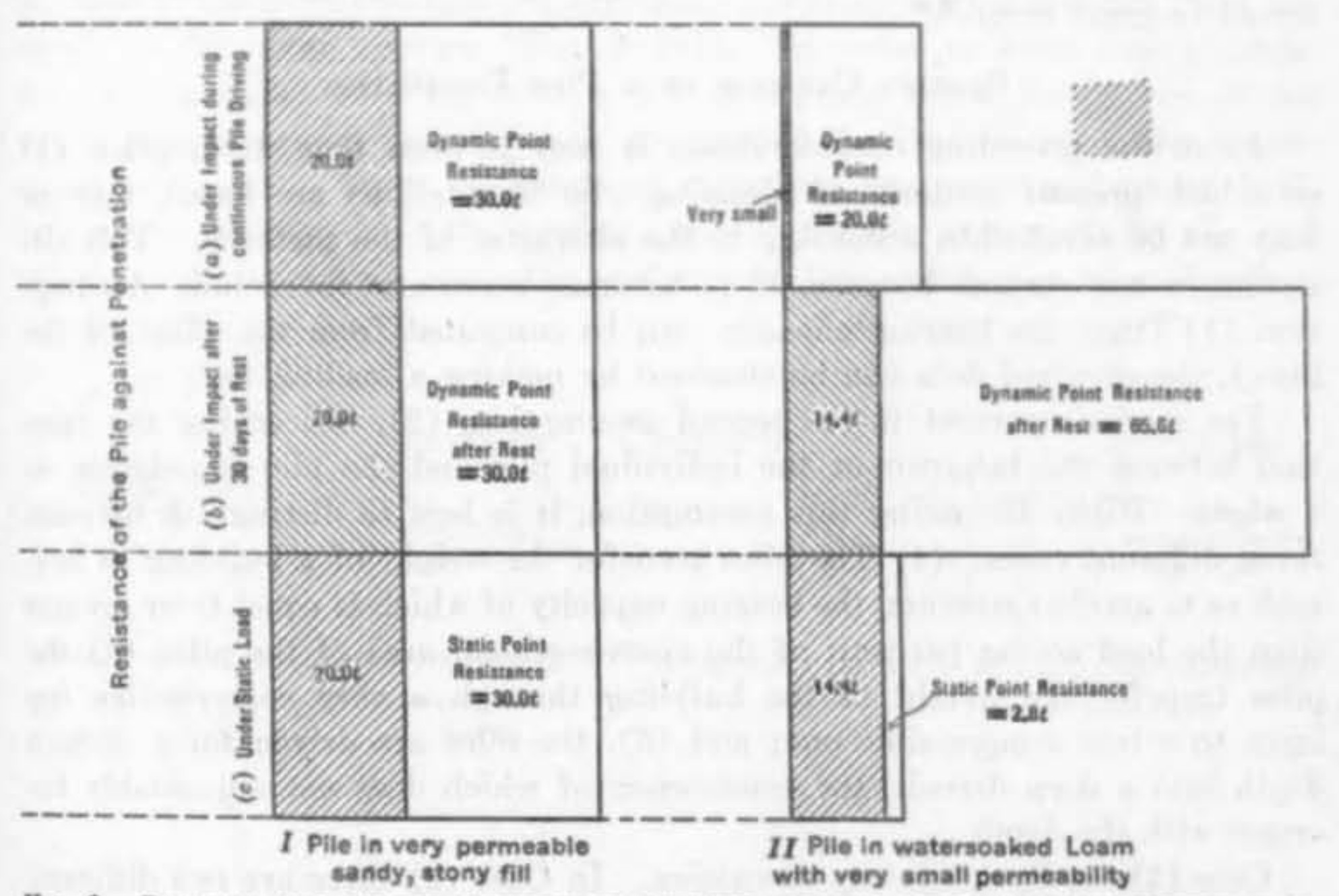
The static and dynamic resistances of the pile are different, or as he puts it, they “may be very different according to whether the pile is slowly forced down or driven by impact.” He also notes that the resistance of a pile to axial load is the sum of the shaft and toe resistances, although he refrains from noting that the dynamic formulae aren’t very good at differentiating between the two.
The capacity of piles changes over time depending upon the soil. Terzaghi notes that this is due to “hydrodynamic stress phenomena,” or the result of “rapid application of loads or pressures on water-soaked materials with a low degree of permeability.” The elevation of pore pressures in cohesive soils is not the only cause of pile set-up, but it is the chief one.
He notes that the pile-driving formulae indicate dynamic resistance, not static resistance. He suggests that piles should be restruck at least 24 hours after they are intially driven, probably the genesis of the practice today. Even with this, he notes that formulae based on the theory of impact are better than the Engineering News formula.
He cites some case studies to show that the Engineering News formula is inconsistent in its ability to predict the bearing capacity of the pile. Foundation books of the era (and for years afterwards) are occupied with stringing case studies one after another; condensing this information into usable (well, sometimes) formulae would have to wait for larger data sets and the ability to process that data. The Dennis and Olson Method for Determining the Static Capacity of Driven Piles is an example of that for a static pile capacity formula.
Terzaghi seems to lean towards estimating the bearing capacity of piles based on the soils into which they are driven, which translates into static formulae such as Dennis and Olson. This has not worked out as well as one would like; the proliferation of formulae, to say nothing of the dispute between alpha and beta methods, has left the static pile field in almost the same state as the dynamic formulae in Terzaghi’s day. Part of the problem is that the whole concept of “bearing capacity” does not translate well from shallow foundations and that failure in deep foundations is generally due to excessive settlement. Terzaghi presented an extended discussion on bearing capacity, but it is beyond the scope of this study.
It’s worth noting that Terzaghi’s paper took 31 pages but the comments went on for another 78, and stretched out for another two years, with Terzaghi adding 25 of his own for response. Not all of this concerned the dynamic formulae, but enough of it did that Terzaghi mentioned it in his final summary. Some of the responses are as follows:
The author’s obervations respecting the application of the customary pile-driving formulus are probably justified by the facts, since there are few engineers, having occasion to drive piles under varying conditions, who have not been impressed by the variation between actual and computed capacities. Fortunately, the Engineering News formula has usually given results that are at least on the safe side, and until engineers become more enlightened respecting the factors that produce the observed departure from theory, theywill probably do well to stick to that formula as the most dependable guide available. (Charles R. Gow)
About 1900, the speaker abandoned the use of the Engineering News formula. A demonstration of its ineffectiveness was had in connectoin with some work that was being supervised by a certain governmental group. Certain requirements were laid down as to the supporting power of the piles, and the Engineering News formula was to be used. Those responsible were asked if they would be satisfied with a certain weight of the hammer, dropping a certain number of feet. They said they would. The speaker then told them to apply the formula and they found that the result was a negative quantity. (E.P. Goodrich)
The writer is heartily in favor of the abandonment of the Engineering News formula for piles, and the adoption of one similar in nature to that suggested by the author, although he would prefer to disregard pile formulas entirely and make a separate study for each foundation type. That would eliminate the dangerous conditions resulting from group application to single pile tests or formulas. (George Paaswell)
As to the use of piling formulas, the cogency of the reasoning as the variation of the hydro-dynamic resistance with the duration of the applied forceis complete. The new “derivation” of the Engineering News formula is most interesting and calls attention to the fact that the assumed constancy of the second term in the denominator of that formula is even more arbitrary than is generally supposed. (Herbert Chatley)
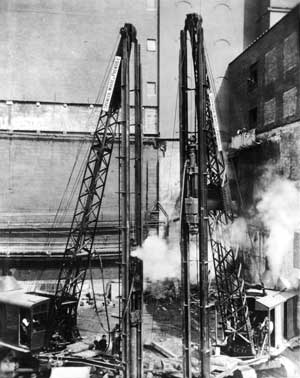
Two rigs at once with Vulcan hammers speed up work for Spencer, White and Prentis, one of the pioneering firms in deep foundations installation. In 1936 Lazarus White reported that “I read some papers last night where some of these pile driving formulas were derived, and the result was that my sleep was very much disturbed.”
The writer’s first foundation experience, involving much wood pile-driving, had a disastrous effect on his faith in the Engineering News formula. No single experiment conformed to it and to “hit the target” of an observed result, was like shooting at a distant pin with a blunderbuss…To cover the use of steam hammers, then coming into use, Wellington arbitrarily changed his denominator, S+1, to S+0.1 giving no good reason except that the more rapid blow of the steam hammer ought to give that much better results. As a matter of fact, there is much variatoin in the rapidity with which steam-hammer blows are struck. The Vulcan hammer is nearly as slow as the drop-hammer and the double-acting hammer is much faster. The Engineering News formula, now incorporated in many building codes, has done a great deal of harm, because its official character has misled owners and engineers as to its reliability. The writer has encountered cases where pile foundations, conscientiously driven to the Engineering News formula, have failed. He has repeatedly checked results by using the formula, testing the driven piles with hydraulic apparatus, and has found the formulas decidedly inaccurate. The use of the Engineering News formula has checked progress. Because of its official adoption, engineers have often computed pile values by it and have not made tests which they would otherwise have made. (Lazarus White)
Terzaghi’s own summary of the discussion on the Engineering News formula is brief and to the point:
The Engineering News Formula received all the comment it deserves and few engineers seem to be willing to defend it.
How did the Engineering News Formula Become So Popular?
Except for Terzaghi’s mention of some of the formulae featured in Goodrich, he and his audience were focused on only one: the Engineering News formula. That’s because, in the two score since its publication, it had become the “standard” dynamic formula, at least in the United States. How did a formula with such problematic results come to dominate the scene with so much competition from other formulas?
There are three main reasons for this:
It was simple to use and calculate. In an era where the slide rule ruled and computatinal power was limited, it was about the simplest of the dynamic formula from a mathematical standpoint. Only the Sanders formula was simpler and its limitations were evident. Also in an era where long division was actually taught and used, even the slide rule could be dispensed with. For example the Trautwine formula, which had a better track record, required a cube root.
It could be used by people of varying educational levels. Terzaghi and the engineers who responded to his paper were very much the elite: many of the contractors, owners and their inspectors did not have a great deal of formal education. A simple formula such as the EN had a great deal of appeal to this kind of audience. For state highway departments and DOT’s, the educational issue was so urgent that the FHWA developed a training course for their engineers and inspectors, which is embodied in the Soils and Foundations Reference Manual, Volume 1 and Volume 2.
Because of (1) and (2), it found its way into many codes, as was attested by Terzaghi’s commenters. Once this happens getting it out was no simple business, as the wave equation proponents found out the hard way fifty years later.
Terzaghi’s strength was in his deep understanding of the behaviour of soils, an understanding which resulted both from experimental and experiential practice and the application of the proper theory to the actual behaviour. That combination revolutionised geotechnical engineering, and secured his place in the profession.
Most soils behaviour is slow except if something bad happens. Pile dynamics at any level, however, involves the rapid movement of pile and soil alike, plastic soil displacement and remoulding. Such a problem is more the province of the mechanical engineer than the civil, which is why progress in the field has been difficult: it is beyond the skill set of most civil engineers, let alone geotechnical ones. It took Raymond’s Chief Mechanical Engineer E.A.L. Smith and computer power to break the logjam and put pile dynamics on a more scientific basis, and much of the progress before and since has been due to the involvement of people more skilled in dynamic phenomena.
Such skill, however, wouldn’t wait long after Terzaghi’s paper was disseminated. A “black swan” event was about to take place, and that from Australia, the original home of black swans, that would begin the sea change in pile dynamics that many who responded to Terzaghi’s paper–and Terzaghi himself–had hoped for.


 vulcanhammer.info
One thought on “An Industry Gets Restless: Terzaghi’s 1929 Paper on Dynamic Formulae and the Response”