
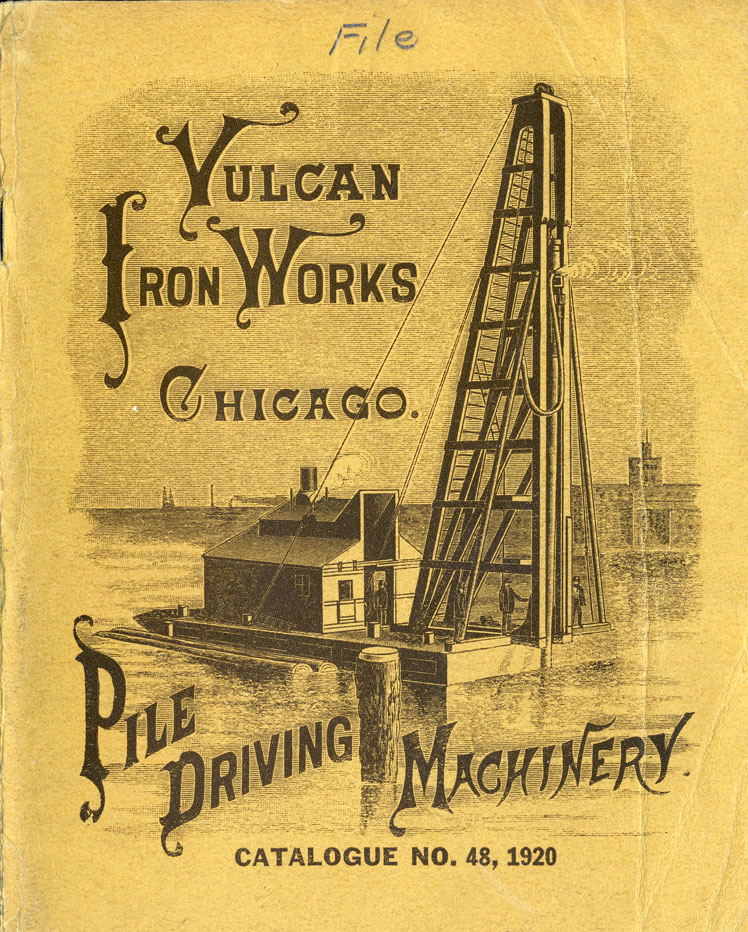
As a way of starting off the new year, and at the request of one our visitors (and someone who facilitated saving much of this information, thanks) here is presented Vulcan Catalogue No. 48, 1920, which can be downloaded here.
I’ve used material from this particular catalogue in the past. This is the first catalogue I have with all of the pages present and accounted for; I have catalogues dating back to 1906, but their condition isn’t the greatest, to say the least.
The catalogue is comprehensive, reflecting the fact that Vulcan’s dealer network was limited, to say the least, and a large portion of its sales were direct. It’s an interesting “one stop shopping” approach that manufacturers like ICE, APE and Conmaco (the last at Vulcan’s direct expense) developed in the last half of the twentieth century.
Vulcan’s statement on the fence post driver (p. 14) that “The hammer is raised by horsepower direct, an extra horse being used solely for that purpose.” is priceless.
Some samples of posts in the past that have used catalogue information from this era are as follows:
- The Engineering News Formula, and Its Treatment in Early Vulcan Literature. Vulcan’s assessment of the accuracy of the EN formula was sour, to say the least, even at this date.
- In the Catalogue: Vulcan Leaders, Rigs and Accessories, 1906-1931. Vulcan’s catalogue didn’t vary much from year to year during this era, so that catalogue you have here is representative.
- The Limitations of Dynamic Formulae. Vulcan’s opinion of EN was only marginally better, probably under pressure from the universal application it had obtained.
The catalogue includes the #5 sheeting hammer but not the California series of hammers.
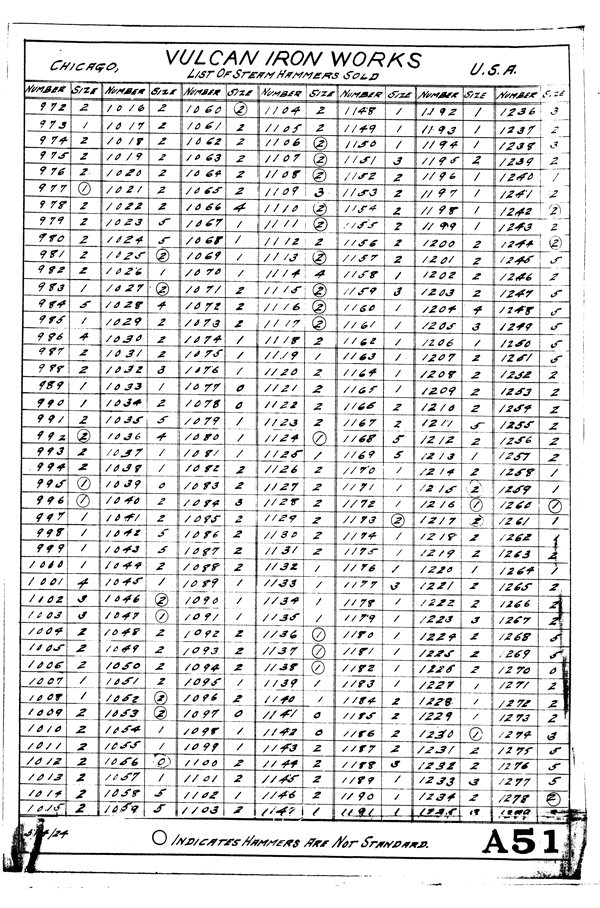
1920 is an interesting point in Vulcan history. The Spanish Flu had come and gone; the Warrington family had survived it intact. But William H. Warrington, who had run the Iron Works pretty much since incorporation in 1881, would pass away the following year, leaving it to his brother James. If you’re interested in what sizes of hammers were being produced at the time, 1920 was a lean year, with only two serial numbers (1258 and 1259) being produced. You can see the hammers produced around those by looking at the chart to the right.
I’m not sure whose hand-written notes are scattered in the catalogue; many of them refer to the Chicago drawings, some of which are also reproduced on this site.

 vulcanhammer.info
One thought on “1920 Vulcan Catalogue of Pile Driving Machinery”