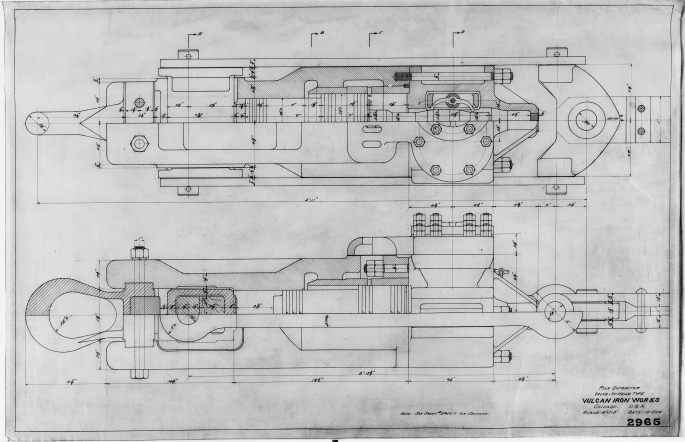
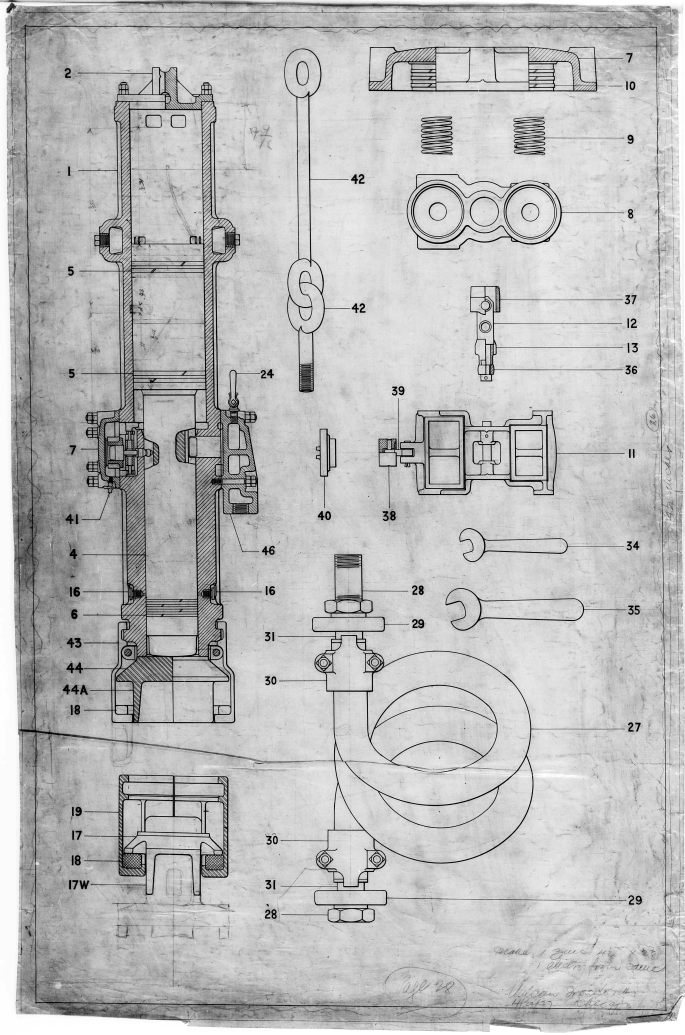
The Vulcan Pile Extractor was the last major design by James N. Warrington (U.S. Patent 1,736,104) to enter production, which it did in 1928. The extractor uses a simple, valveless design where the ram is thrown upward by the incoming steam or air. It strikes an anvil located in the top of the machine. The … Continue reading Vulcan Pile Extractors, and the Wood Pile Puller
Category: Vulcan: the First Hundred Years
A Product Line in Transition
From the late 1880's until the end of the "Roaring Twenties," Vulcan prospered with its Warrington-Vulcan steam hammers, supplemented by the California hammers.ย However, as steam was making its exit as the prime mover of construction equipment, it became evident that the Vulcan product line needed some upgrading.ย This is a survey of some of … Continue reading A Product Line in Transition
California Series Pile Hammers
Although not the "flagship" of the Vulcan line, the "California" series pile hammers are an interesting part of the company's story, both in themselves and how they came about. The California series hammers were developed by James N. Warrington. His ill health forced him to leave Chicago and live in Los Angeles, California. It was … Continue reading California Series Pile Hammers
327 North Bell Avenue Facility
William H. Warrington (1846-1921), the major investor and manager of Vulcan Iron Works until his death, at which time the direction passed to his brother James. Of the three sons of Henry Warrington, he was without a doubt the best businessman, but occasionally things did not go according to plan, as was the case with … Continue reading 327 North Bell Avenue Facility
Vulcan Drop Hammers
Although Vulcan is best known for its air/steam hammers, out of necessity as much as anything Vulcan produced a line of drop hammers for most of its history. Until the advent of "automatic" hammers such as the Warrington-Vulcan hammers, drop hammers were the only way driven piles were installed. Drop hammers were (and still are) … Continue reading Vulcan Drop Hammers
In the Catalogue: Vulcan Leaders, Rigs and Accessories, 1906-1931
Although Vulcan became a "one-product" company with the success of the Warrington-Vulcan hammers, it furnished a wide variety of accessories and other products to go with its successful pile hammers. From the turn of the century until the Great Depression, Vulcan issued one catalogue to cover the entire line of steam hammers, drop hammers, accessories … Continue reading In the Catalogue: Vulcan Leaders, Rigs and Accessories, 1906-1931
Vulcan “00”: The Big Hammer That Wasn’t
In 1912 Vulcan produced the first Vulcan #0 hammer. With its larger cylinder, columns, ram point, cushion diameter and leaders, it represented an important step upwards from the #1 and ultimately was the progenitor of a long line of Vulcan hammers, including the 0R, 08, 010, 012, 508, 510 and 512. (Specifications for these are … Continue reading Vulcan “00”: The Big Hammer That Wasn’t
Vulcan #5: The First Closed Hammer
Vulcan is best known for its "open type" Naysmith-ancestry hammers. Most of Vulcan's competitors (MKT, Union/Arnott, etc.) produced "closed type" hammers, where the ram was invisible to the users. But Vulcan ventured into the closed hammer type as well. The first of this type Vulcan produced was the #5, shown at right. First produced in … Continue reading Vulcan #5: The First Closed Hammer
Vulcan and the History Channel
It was inevitable that a product line as long in duration as Vulcan's would attract attention outside of the deep foundations industry. In the course of developing the "Tools" program on various types of construction equipment and techniques, the Atlas Media Group (which did productions for The History Channel) contacted Vulcan. In July 2005 their … Continue reading Vulcan and the History Channel
The First Pile Hammers
The Vulcan steam hammer (the use of air came later) began when the company began to manufacture hammers under the patent of Thomas T. Loomis (U.S. Patent 160,781) in 1875. This hammer used many of the main features of the Nasmyth hammer (which had been developed in the UK) but used an improved valve gear. … Continue reading The First Pile Hammers