Some Insight into the Origin of Vulcan’s Pile Hammer Valve System

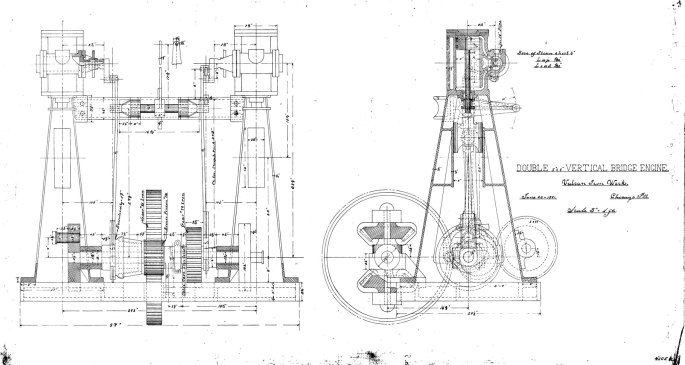
Much of the narrative around Vulcan centres on the development of the Warrington-Vulcan pile hammer design in the late 1880's (and the serial number records aren't the most informative about when exactly the final transition to that design was made.) But how did Vulcan come up with the valve design it made its standard? Some … Continue reading Some Insight into the Origin of Vulcan’s Pile Hammer Valve System
The Basics of Setting the Cut-Off Point for a Vulcan Single-Acting Hammer

The issue of slide bars, full and short stroking and blow rate have always been central to the proper "certification" and operation of Vulcan hammers. In this post we will take a "bare bones," basic approach to the dynamics of the problem with the most basic automatic hammer of all: a single-acting air/steam hammer, in … Continue reading The Basics of Setting the Cut-Off Point for a Vulcan Single-Acting Hammer

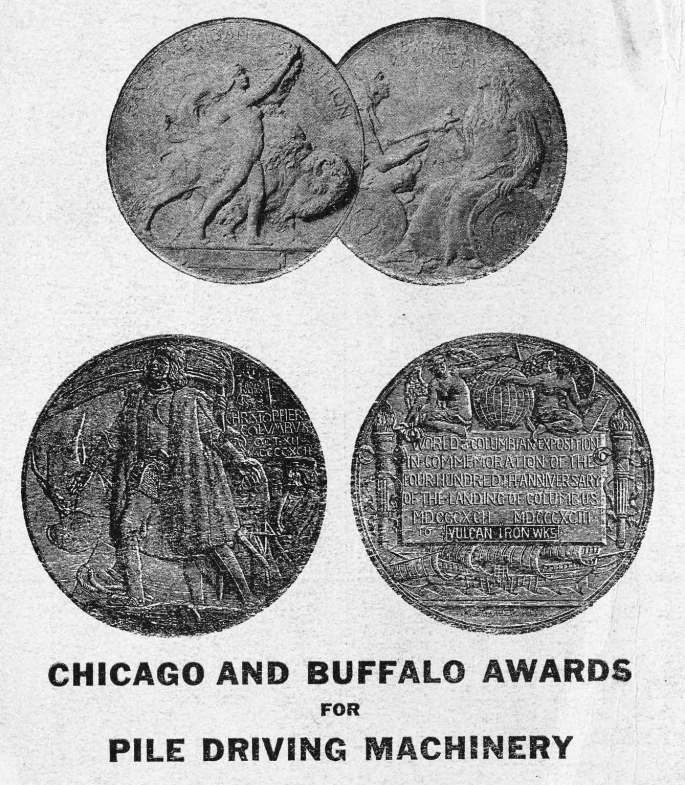
Vulcan’s Awards at the Columbian (Chicago, 1893) and Pan-American Expositions (Buffalo, 1901)

Showing off the product: a diagram of Vulcan's product line exhibition at the Pan-American Exhibition in Buffalo, NY, in 1901. Vulcan participated in most of the "world's fairs" of the era, including the Columbian Exhibition in Chicago. It's worthy of note that all of the products shown here: the leaders, the #2 steam hammer, the … Continue reading Vulcan’s Awards at the Columbian (Chicago, 1893) and Pan-American Expositions (Buffalo, 1901)

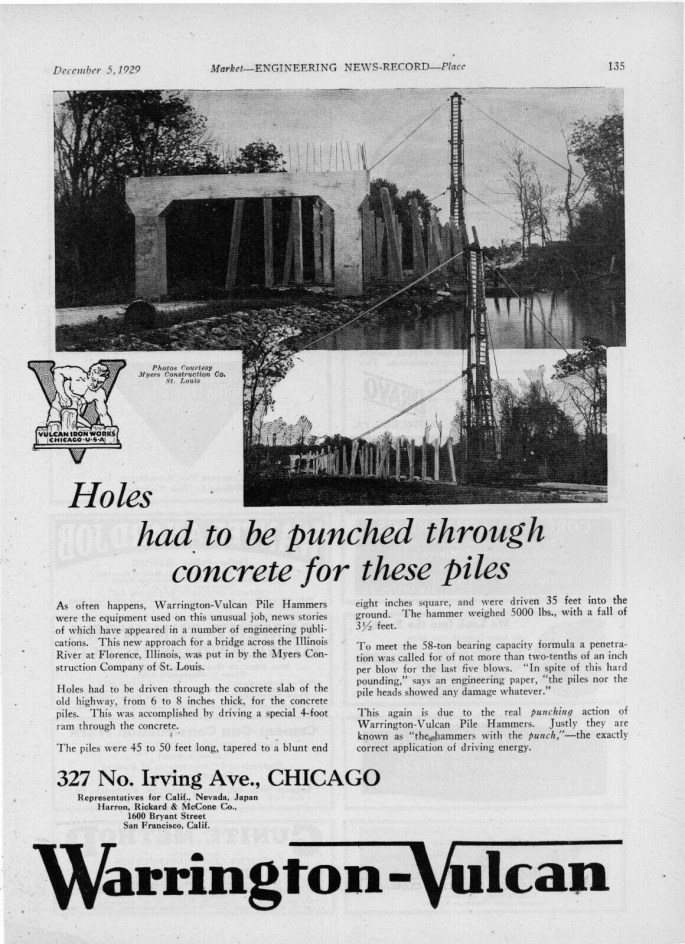
Holes had to be punched through concrete for these piles

This is another ad in our series of Vulcan ads from the 1920's, in this case appearing in the 5 December 1929 issue of Engineering News-Record. But this ad is a departure from the others in several respects. It's not clear from the photos or ad copy what kind of hammer this actually is. The … Continue reading Holes had to be punched through concrete for these piles

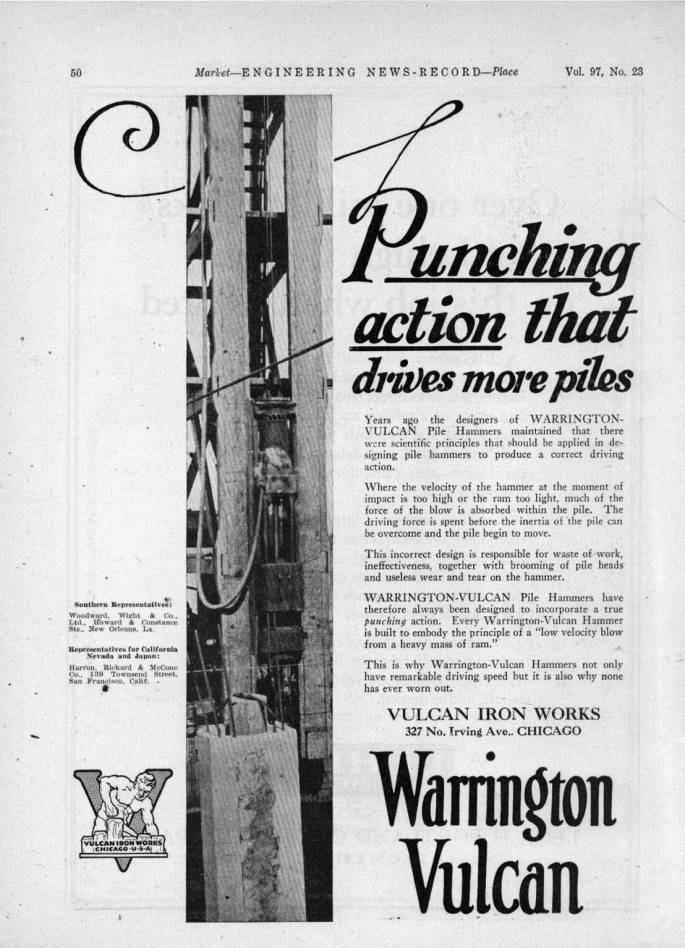
Punching action that drives more piles

Another classic Vulcan ad, this one appeared in the 2 December 1926 edition of Engineering News-Record. It hits (sorry!) on one of Vulcan's favourite themes, namely that of "heavy ram-short stroke," which was Vulcan's design philosophy for most of its existence (or at least until the 560.) The ad explains the superiority of this concept … Continue reading Punching action that drives more piles

Curved Beam Analysis on a Hand-Forged, Non-Rectangular Cross Section

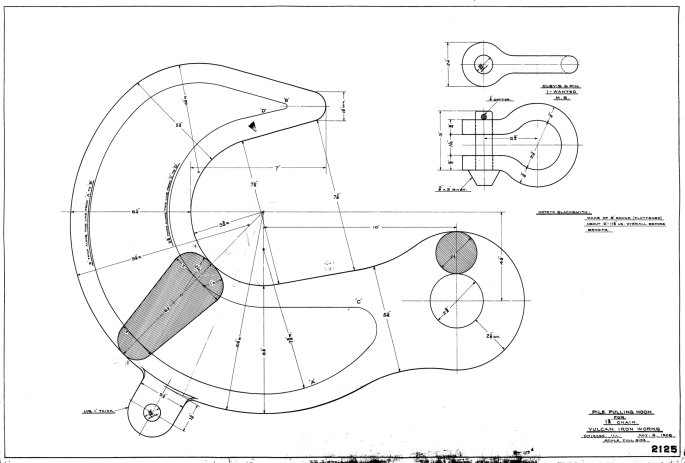
In a recent post I discussed curved beam analysis with a rectangular cross section, and as a follow-up a comparison of that type of analysis with finite element results. Many curved beams, such as the lifting hook shown above, do not have rectangular cross-sections. This is an interesting topic, not only because of the engineering … Continue reading Curved Beam Analysis on a Hand-Forged, Non-Rectangular Cross Section

Vulcan Pile Hammers: Adaptability, Portability, Flexibility, Sensibility and the Ability to Get the Job Done on Time

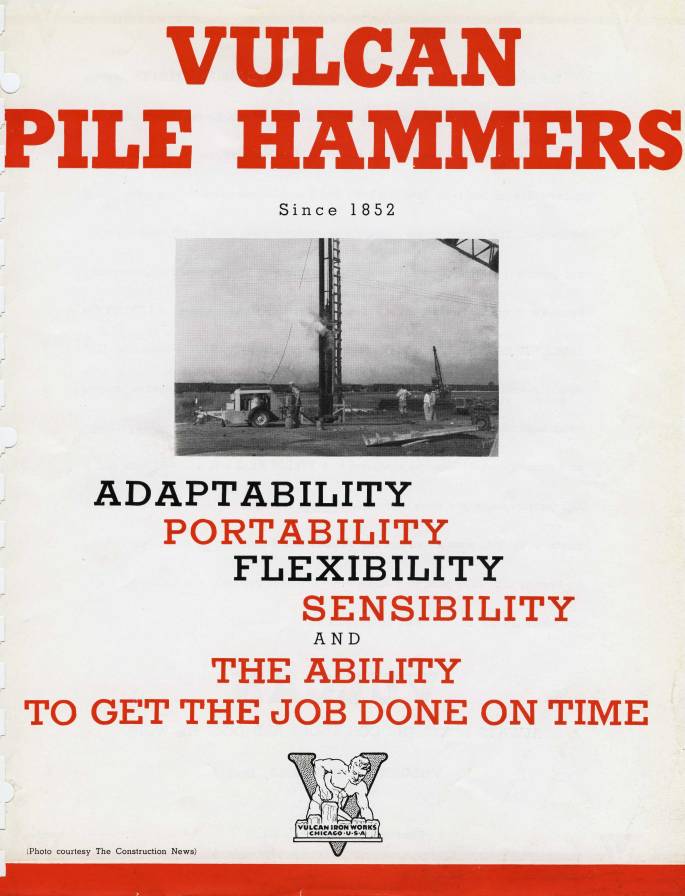
We've featured ads that Vulcan put in Engineering News-Record, but this one was a flyer that Vulcan put out about a successful application of a Vulcan #2 in Memphis, Tennessee. The hammer was run using a Littleford Tank Heater to generate the steam. Vulcan flyer for a #2 driving piles in Memphis, Tennessee, in the … Continue reading Vulcan Pile Hammers: Adaptability, Portability, Flexibility, Sensibility and the Ability to Get the Job Done on Time

This is the Warrington-Vulcan Pile Hammer

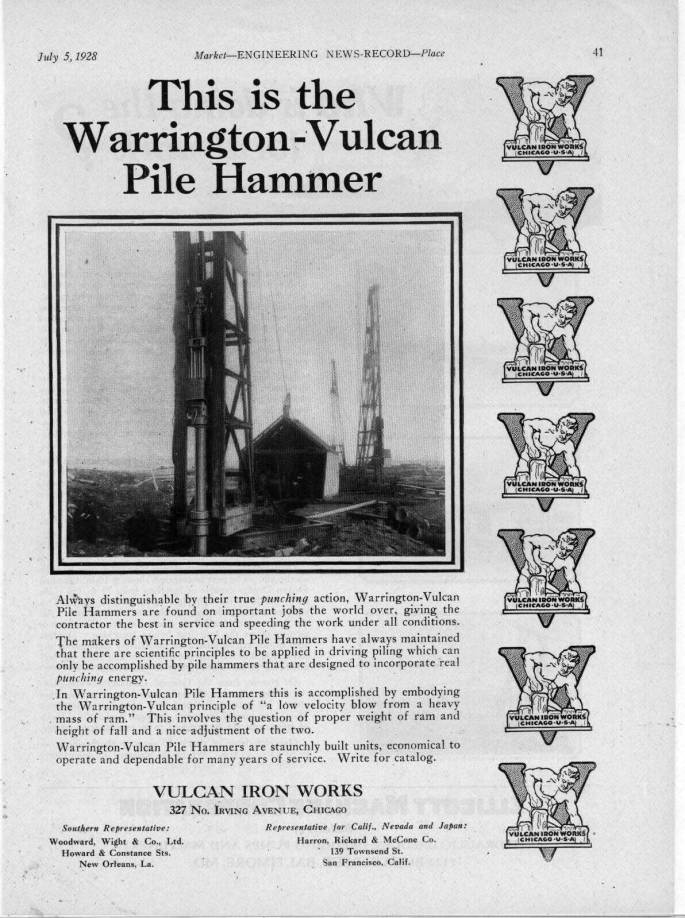
Another ad for Vulcan in Engineering News-Record, this in the 5 July 1928 issue. Vulcan touted the "heavy ram/low striking velocity" feature here, had done so in the past, and would do so again for many years. Specifications for these hammers can be found here. Other ads from the same era: Driving Speed That Makes … Continue reading This is the Warrington-Vulcan Pile Hammer

Stresses for Curved Beams with Rectangular Cross Sections

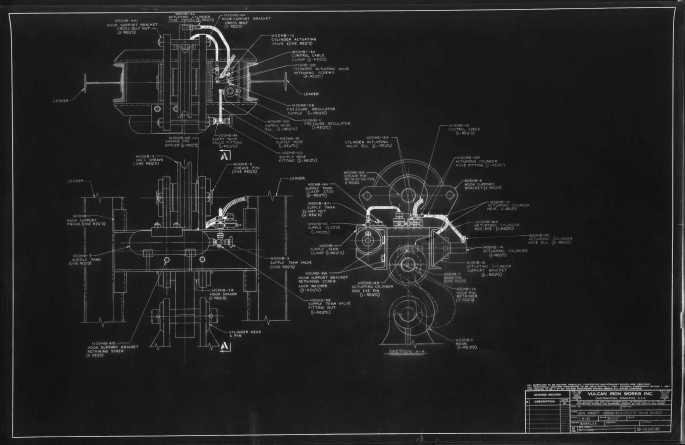
In the early 1960's Vulcan became involved with the Sand Drain hammers. Part of that effort was developing a servo-pneumatic hook block to grab and lift the hammer and everything else what was attached to it. The device is shown above. Vulcan received a patent for it. Here we'll concentrate on one aspect: the design … Continue reading Stresses for Curved Beams with Rectangular Cross Sections

Using a Vulcan #2 for Residential Piling

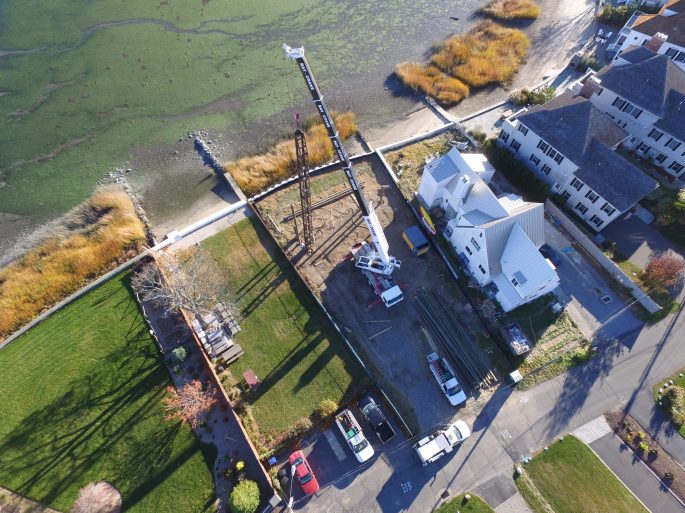
Most residences do not require pile foundations, but some do, generally because of the combination of the size of the house and the geotechincal stratigraphy (read soft.) In Vulcan's history this is generally associated with the New Orleans area, but recently a Vulcan #2 was used to drive residential piling in Connecticut. The whole post … Continue reading Using a Vulcan #2 for Residential Piling