
For more of this book, click here.
Trenchless installation of engineering utilities is used under highways and railways, streets, existing utility networks, etc. In recent years, due to a sharp increase in the volume of reconstruction work at existing enterprises, and the development of water supply, sewerage, electricity, and gas supply networks in built-up areas, improving the technology and equipment for trenchless installation of engineering utilities has become a highly urgent task.
It should be noted that the construction of utilities by the open-cut method, as a rule, entails the stoppage of traffic and a very long duration of work due to the impossibility of their mechanization in conditions where they intersect with previously laid pipelines and cables.
During the construction of a trenchless crossing, the most labor-intensive and complex process is the installation of the protective casing pipe. The difficulties are determined by the need to apply large static forces both during piercing and jacking.
In the latter case, it becomes necessary to perform a highly labor-intensive operation of removing soil from the cavity of the horizontal pipe. In both methods of trenchless installation, the use of vibration technology makes it possible to minimize manual labor and increase the pace of work.
For the first time, vibro-piercing using directional vibrations was proposed at VNIIGS (O. A. Savinov, A. Ya. Luskin, 1958). Preliminary studies have already shown that the jacking force during vibro-piercing can be several times smaller, and the jacking speed significantly greater than with conventional hydraulic jacking.
The works of N. Ya. Kirshenbaum and V. I. Minaev (1968) demonstrated the feasibility of effective application of impact-vibration pipe driving during horizontal tunneling. This possibility was associated with certain conditions of self-propulsion of the pushed pipe under impact-vibration action. However, the introduction of vibration technology into the practice of building trenchless crossings became possible only by taking into account the specifics of these operations.
VNIIGS developed and introduced into construction practice the impact-vibration-pressing equipment UVVGP-400 for the trenchless installation of casing pipes with a diameter up to 426 mm, and the impact-vibration grab UVB-1, designed for removing soil from the internal cavity of steel pipes with a diameter of 1020–1420 mm during their trenchless installation by the jacking method.
The UVVGP impact-vibration-pressing equipment ensures pipe insertion under the simultaneous action of static force and shock impulses created by an impact-vibration mechanism. Another feature of this equipment is the self-regulation of the spring tension of the impact-vibration mechanism depending on the soil resistance to the insertion of the driven element, which allows operating with an optimal combination of the magnitude of the static pressing force and the most effective impact mode (V. I. Teplikov, 1981).
The impact-vibration mechanism, consisting of a vibration exciter and an impact attachment with a driving cap, moves under the action of a pulley block along a sectional guide. Reactive forces from the pipe driving into the soil are absorbed by an anchor frame, which is secured in front of the obstacle using inventory sheet piles.
The first section of the pipe is equipped with a conical tip. The process equipment is controlled from a special control station (Fig. 125).
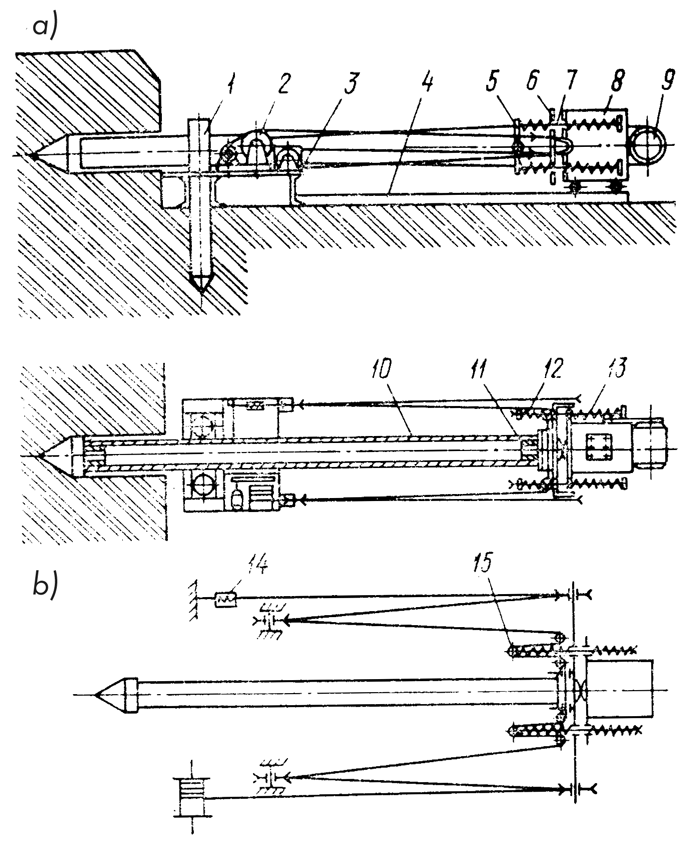
Pipe laying work consists of the following operations: equipping the lead section of the casing pipe with an inventory conical tip; installing the pipe in the guide sleeve and in the driving cap of the impact-vibration mechanism; turning on the impact-vibration mechanism; turning on the pulling winch and driving the pipe; returning the impact-vibration mechanism to its starting position; mounting and welding the next section of the pipe.
During the operation of the equipment, several dozen casing pipes with a diameter of 273–426 mm were laid over a length of 17–40 m in sandy, clayey, and filled soils during the construction of crossings under highways and railways (V. I. Teplikov, A. P. Ustyuzhaninov, 1984).
With a significant increase in soil resistance during pipe laying and a drop in the driving speed to 0.06 m/min, one should switch to telescopic laying using a smaller diameter pipe. This technology has been proven in practice and made it possible to ensure the installation of a 70 m long pipe at high speed.
When using the UVVGP-400 equipment, the direction of the piercing specified by the first section is maintained. The results of operating such equipment have shown its high efficiency and feasibility of wide introduction during trenchless laying of steel pipe casings.
The impact-vibration grabber UVB-1 is a self-propelled machine that has the ability to self-advance along the pipe being laid toward the face, and to forcefully drive into the soil that enters the pipe during its pushing. The movement of the UVB-1 to the face and its embedding into the soil are carried out under the action of impact impulses created by the impact-vibration mechanism and transmitted to the machine body and the soil sampler connected to it.
The UVB-1 (Fig. 126) consists of an impact-vibration mechanism with an electric motor drive, housed in a cylindrical body and rigidly connected to the soil sampler. The impact-vibration mechanism is able to move relative to the cylindrical body and is connected to it by a spring system. The body has an anvil and protrusions, and the impact-vibration mechanism has matching strikers to transmit impact impulses in the direction of driving and backward to facilitate the extraction of the UVB-1 grabber from the face.
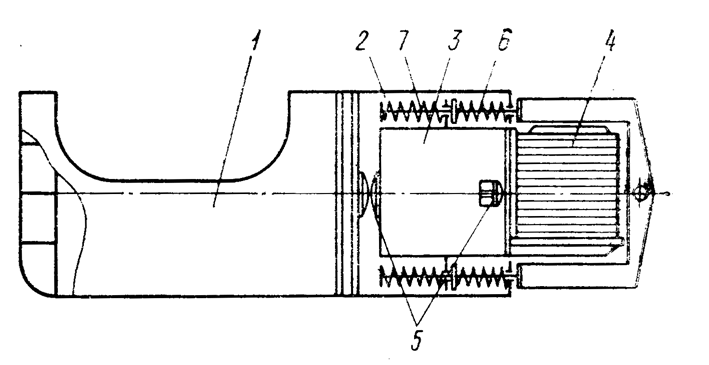
To reduce the dynamic impact on the lifting hook during the unloading of the UVB-1, a spring shock absorber is usually used.
Soil extraction from the pipe being laid with the help of the UVB-1 is carried out cyclically, but does not depend on the periodic operation of hydraulic jacks providing the pushing of pipes into the soil.
The technological cycle of driving horizontal boreholes includes:
- Self-advancement of the impact grabber (due to asymmetry of impact actions and reactive forces of the springs) along the pipe to the face;
- Filling of the soil sampler during impact-vibration penetration of the grabber into the soil;
- Extraction of the grabber by static force through self-movement under the action of the vibro-exciter, delivering blows in the reverse direction;
- Turning of the grabber to a vertical position and unloading it in impact mode.
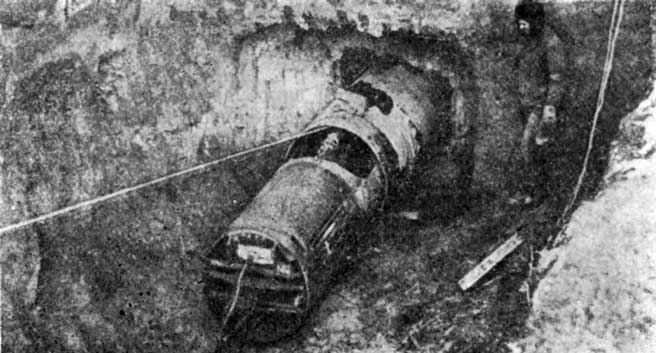
To reduce the extraction force, the design of the UVB-1 provides for the possibility of backward impacts when applying a static extraction force. The use of UVB-1 is possible in the entire range of soil conditions where static pushing of the pipe being laid is ensured. The time of one cycle of the installation for cleaning the pipe from 1 meter of pushed pipe is about 10 minutes, while the operating time at the face does not exceed 2–3 minutes. UVB-1 makes it possible to completely eliminate manual labor at the face, increase productivity, and improve work safety. The operation of the impact-vibration grabber during horizontal borehole driving with a pipe diameter of 1020 mm in dense loams is illustrated in Fig. 127.
The vibro-impact installation UVG-51 is designed for laying pipes with a diameter up to 530 mm by the method of vibro-impact puncture, with a diameter of 530–1020 mm—by means of vibro-impact jacking. The design of the installation was developed by MINKhiGP named after I. M. Gubkin and manufactured by the Gazstroymash plant and implemented in Minneftegazstroy.
When laying pipes using the vibro-impact puncture method, a cone-shaped tip is welded to the lead end of the pipe, and it is driven in by blows from a impact-vibration hammer with an additional static load. When laying pipes using the method of shock-vibration jacking, no tip is installed on the front end of the pipe; instead, a soil bucket (bailer) is placed inside the pipe. During the pipe driving process, the open end cuts into the ground for a certain distance, and then the soil bucket is driven into the ground by the impact-vibration hammer, picks up the soil, and, using a cable, moves to the discharge window of the pipe. Under the action of blows from the impact-vibration hammer, the soil is dumped through the bucket window into the discharge windows of the pipe on both sides of the installation.
The driving process consists of separate, periodically repeating cycles, in each of which the advancement of the pipe alternates with the removal of the soil core by the soil bucket.
Analysis of the use of vibration technology in works on trenchless pipeline installation shows the following advantages:
- Mechanization: Opportunity for complex mechanization of work, eliminating manual labor.
- Preparation: Reduction in the volume of preparatory work.
- Timeframes: Shortening the timelines for constructing crossings through obstacles.


One thought on “Application Of Vibration Technology In Trenchless Pipe Installation”