
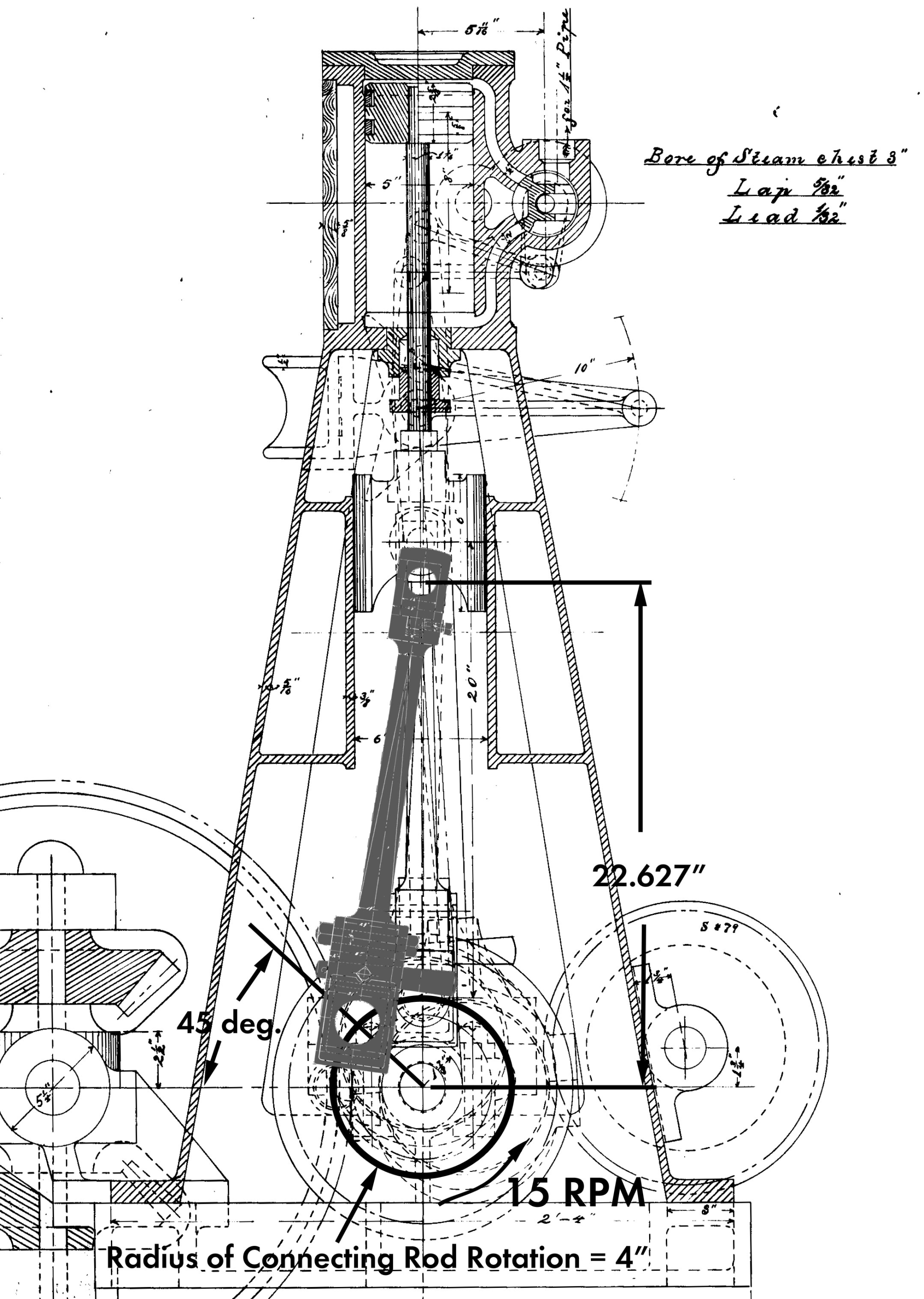
In the earlier post Some Insight into the Origin of Vulcan’s Pile Hammer Valve System we looked at the Corliss valve and its application first to steam engines and later pile hammers. In this post we’ll look at these engines from another standpoint: analysing their rotational action using the method of instantaneous centre of rotation. The basic engine is below.
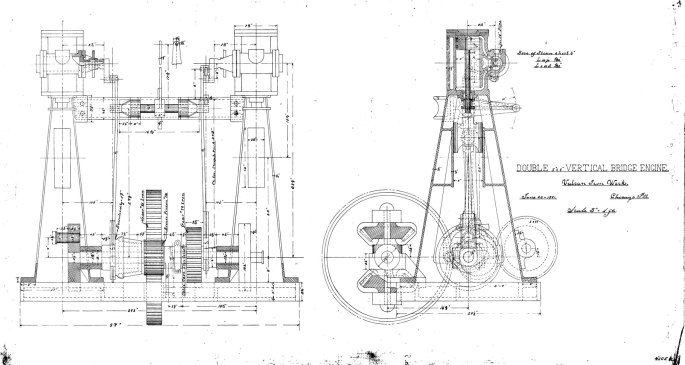
The problem can be stated as follows: A single piston steam engine is shown on the next page. The connecting rod (in gray) transmits power from the piston at the top (which moves strictly vertically, as does the upper connecting rod pin) to the crankshaft at the bottom (which rotates around its centre axis.) The distance between the two pins on the connecting rod is 20”, and radius around which the lower connecting rod pin rotates is 4”. The crankshaft rotates counter-clockwise at 15 RPM. The arrangement shown in Figure 1 shows the connecting rod at top dead centre.
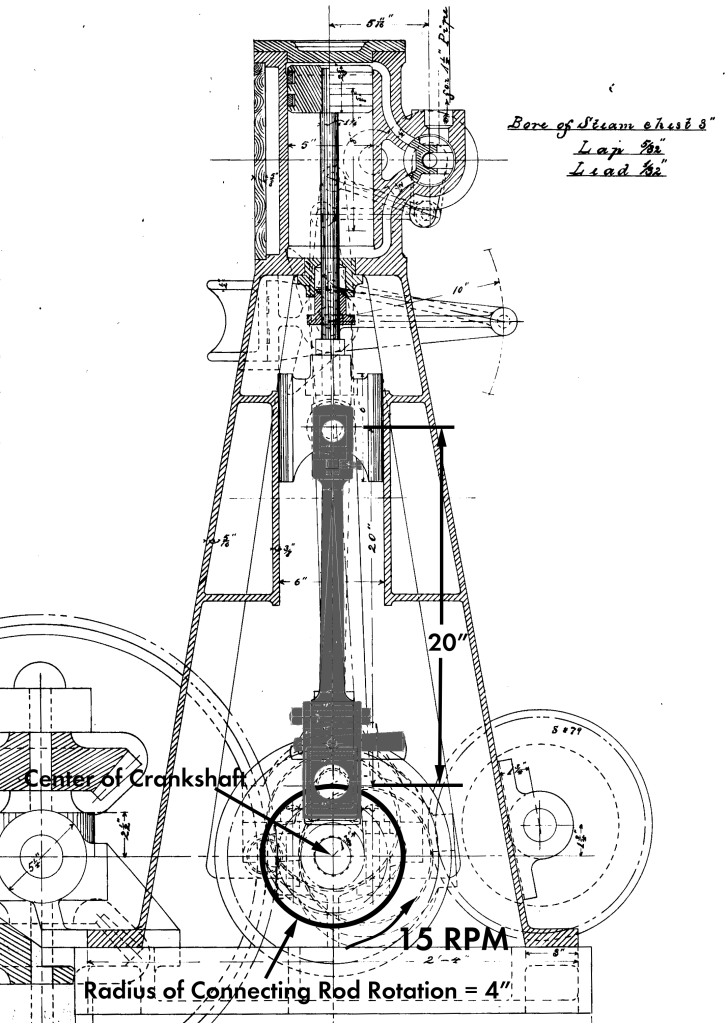
Now consider the system as shown in Figure 2. The crankshaft has rotated from top dead centre and the lower connecting rod pin is 45 degrees from the horizontal axis. At this point the distance from the upper pin and the crankshaft centre is 22.627”. At this instant determine the velocity of the upper connecting rod pin.
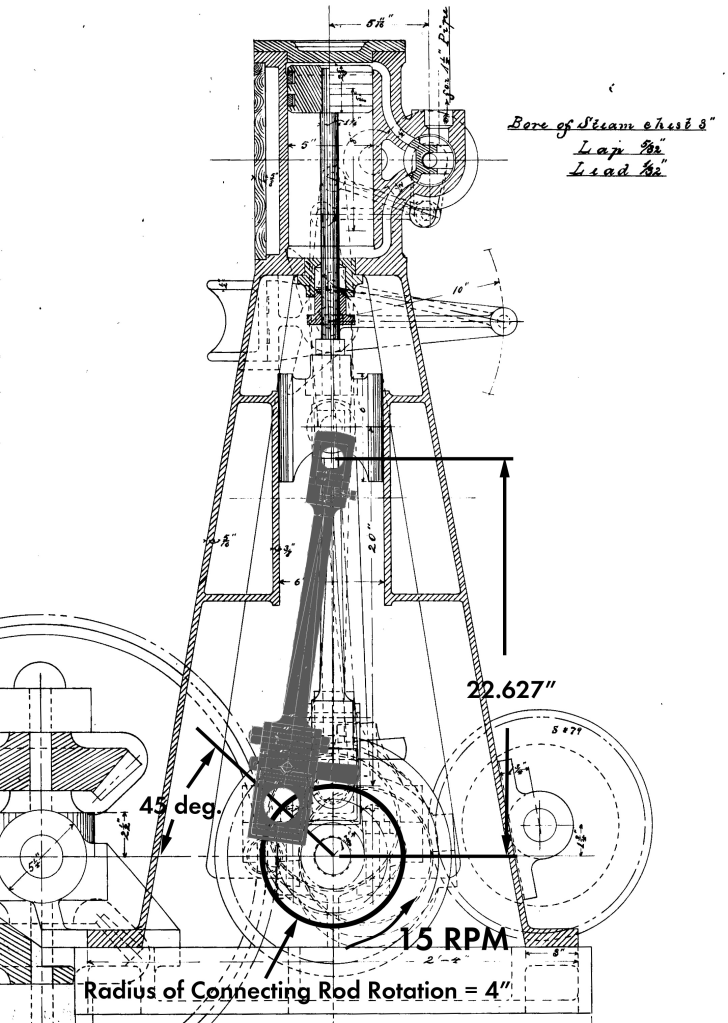
Note that the rotational speed is conjectural; the dimensions are taken from the drawing.
The simplest solution to the problem (but not the only one) is to use the instantaneous center of rotation, as shown below.
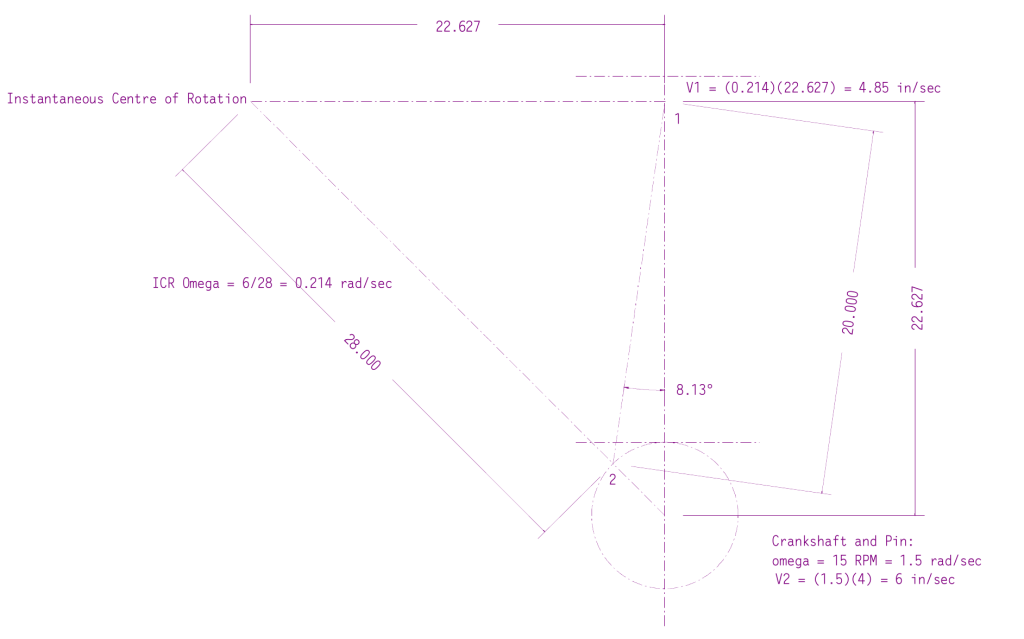
It’s possible using the law of sines to determine the angle between the vertical and the crankshaft at the point in question. But it’s unnecessary, for reasons which will become apparent.
Since Point 1 is constrained to translate vertically, its radius of rotation is horizontal to the left. Point 2 is constrained to move tangential to the circle of rotation; since the angle is 45 degrees, its radius of rotation is 45 degrees from the center of the crankshaft as shown. Where the two meet is the instantaneous center of rotation.
Although the above solution is graphical, once again because of the 45 degree angle, the triangle formed by the center axis of the piston motion/crankshaft center has two equal legs with a length that was given for one of them. The hypotenuse is simply 32” long; since 4” of that is the crankshaft offset, that leaves 28” for the radius of rotation for Point 2.
The tangential velocity of Point 2 is rω = 6 in/sec. Since the radius of rotation for Point 2 is 28”, the instantaneous rotational speed of the crankshaft = ω = v/r = 6/28 = 0.214 rad/sec. The velocity for Point 1 is thus rω = (.214)(22.627) = 4.85 in/sec.


One thought on “Solving a Dynamics Problem using the Instantaneous Centre of Rotation with a Vulcan Design”