
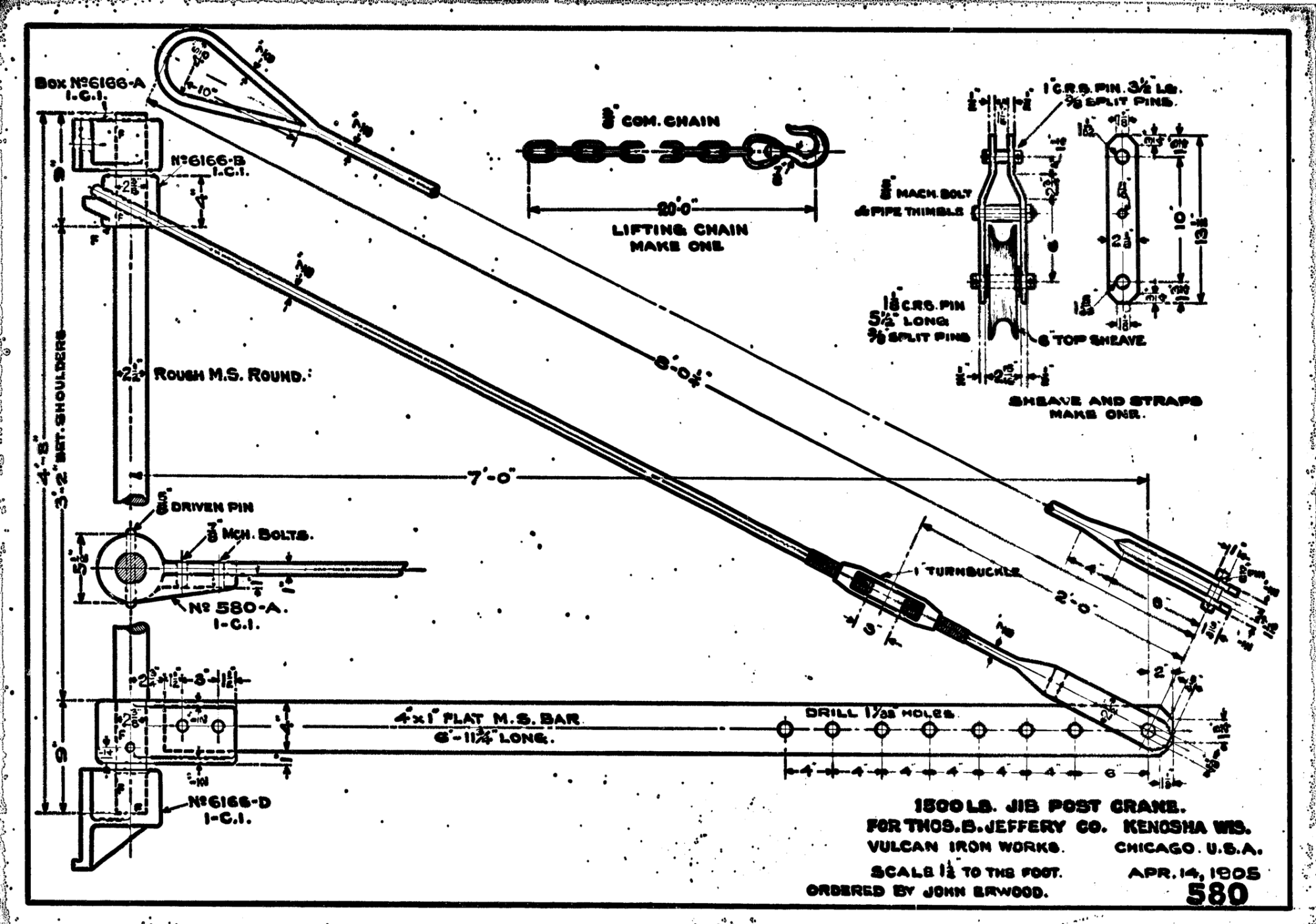
As this site has documented, Vulcan produced more than pile driving equipment, especially in the years before World War I. One of those is the 1500 lb. jib post crane depicted above, which Vulcan produced for the Thomas B. Jeffery Company in Kenosha, WI, an automobile manufacturer. (It ultimately became Nash motors, which in turn became American Motor Company before it was bought out by Chrysler.) The date on the drawing is 14 April 1905. It’s a simple device, one that finds its way into many machine shops including Vulcan. Vulcan made it a “turnkey” project including the sheave, lifting chain and wall brackets.
We’re going to use this, as we have done in the past, to illustrate some engineering principles, but doing it in a way that will both illustrate the principles and demonstrate how it’s sometimes not obvious (at first) how they can be directly applied to real structures and devices.
Let’s draw a force diagram (along with some other information) below. Although the crane allows for multiple points of attachment of the load to the beam, we’ll consider the leftmost point, which is 52″ from the left support.
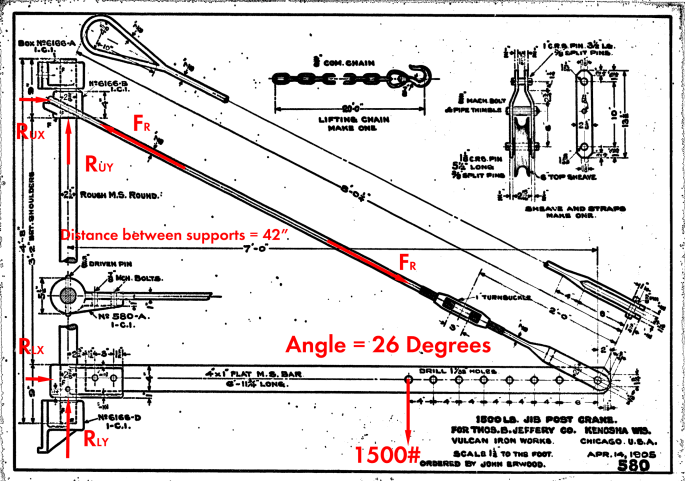
What we want to find out is the following:
- Whether the supporting rod can be considered a “two-force member”
- If so, axial force in the rod
- Reactions for both the beam and the rod at the vertical supporting hinge rod
Proceeding, let us consider the “two-force member” assumption:
- We will assume that the system is simply supported at the two points on the hinge rod. We do this based on the following:
- Slack between the hinge rod and the two collars is sufficient to allow rotation of the hinges
- Lower bracket supports y-axis reaction of lower support
- Friction (or an additional pin) supports the y-axis reaction of the upper pin
- Because of the pinned supports at both ends of the rod, it can only transmit axial loads (no moments) and is thus a “two-force member”
Strictly speaking, a two force member is a rigid body where the two forces are all a) on the same line of action and b) equal and opposite. To accomplish this we have to do something that isn’t really taught in contemporary statics courses: how to translate the physical reality of the device into the ideal supports we’re taught about, and whether that is entirely appropriate. (It’s a good assumption that Vulcan used a rigid body, ideal support approach when it designed this jib post crane.)
Let’s move on to write the summation of force equations:
- X-direction: RUX + RLX = 0
- Y-direction: RUY + RLY – 1500 = 0
We will take moments around the upper support to eliminate complications due to the rod force FR. The moment summation is thus 42 RLX – (52)(1500) = 0 (using “old coot” methods.) We can thus solve this to RLX = 1857.1 lbs and, from the x-direction forces, RUX = -1857.1 lbs.
- Because of being a two-force member, the vector sum of the upper reactions must equal the rod force, thus
- RUX = – FR cos (26) (negative to close the force triangle)
- RUY = FR sin (26)
- Solving,
- FR = 2066.1 lbs.
- RUY = 905.7 lbs.
From the y-direction summation RUY + RLY – 1500 = 0, we can solve for RLY = 594.3 lbs. There is a step down between the diameter of the exposed hinge rod and the hinge rod through the upper support, which means:
- The reaction is transmitted through the shoulder in the hinge rod;
- The upper reaction actually ends up on the lower support; and
- The hinge support actually requires a separate analysis.
Based on this, we have accomplished the following:
- We have illustrated the two-force member concept, which is familiar to those who deal with, for example, mobile hydraulic cylinders.
- We have worked our way from an actual design to make the assumptions possible for conventional statics analysis.
- We have seen justifications for design features (like the stepped-down vertical hinge rod) using our statics calculations.
As a side note, in the early 1970’s my brother and I went on a wild goose chase for a new car. If my father had invoked the existence of this item, he could have forced us to get an AMC Gremlin, which at least had a six- (and sometimes eight-) cylinder engine and air conditioning, really nice in South Florida. Instead my brother led me on The Saga of the Baby Blue Pinto.

 vulcanhammer.info