The S-402A Impact-Vibration Hammer

I recently wrote a paper entitled Development of a Parametric Model for the Simulation of Impact-Vibration Pile Driving Equipment. It was presented earlier today at the 2023 Spring Research and Arts Conference; the slide show for the talk is here. One of the impact-vibration hammers featured--probably the "cleanest" one in terms of the results--is the … Continue reading The S-402A Impact-Vibration Hammer
Vibratory Pile Driving: Using Both Longitudinal and Rotational Vibrations Isn’t New

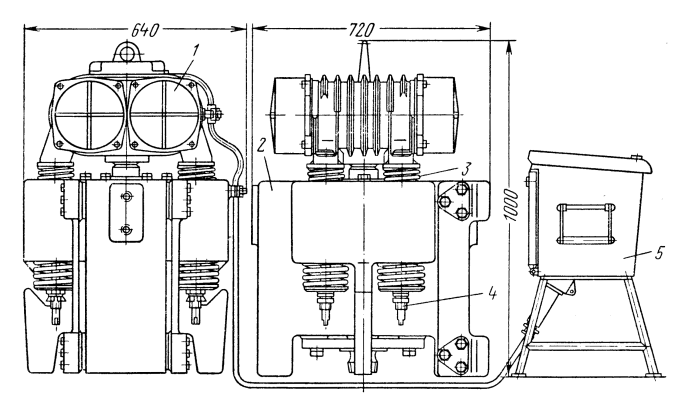
I found the recent paper by Metrikine et.al. (most of the authors are from Delft University) entitled "GDP: A New Technology for Gentle Driving of (Mono)Piles" interesting about combining longitudinal and rotational vibrations to install piling in a "gentler" manner. But is this new? Not really, as can be seen in this excerpt from Immersion … Continue reading Vibratory Pile Driving: Using Both Longitudinal and Rotational Vibrations Isn’t New

Two Papers on Vibratory and Impact-Vibration Hammers

We present two papers on these topics, one first presented last year and one which has just been completed. Inclusion of Rotational Inertial Effects in Power Consumption Calculations for Vibratory Pile Equipment Abstract: Virtually all treatments of power consumption and modelled performance for vibratory pile driving equipment assume a constant rotational speed of the eccentrics. … Continue reading Two Papers on Vibratory and Impact-Vibration Hammers

Vibratory Drivers, Impact-Vibration Hammers and Apartment Buildings

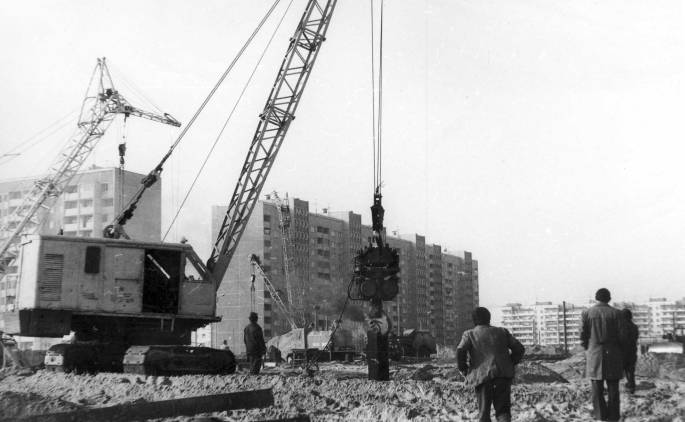
In Vulcan's last years, its relationship with Soviet (and after that Russian) people and institutions enabled it to obtain some interesting information about their vibratory and impact-vibration hammers. Some of this can be found at our post Material on Vibratory and Impact-Vibration Equipment from the Soviet Union and Russia. Part of that was a collection of … Continue reading Vibratory Drivers, Impact-Vibration Hammers and Apartment Buildings

About that “Warrington Method” For Vibratory Pile Drivability

Every now and then something comes up that you really didn't expect. That took place with a paper published this year cited "W.J. Lu, B. Li, J.F. Hou, X.W. Xu, H.F. Zou, L.M. Zhang, "Drivability of large diameter steel cylinders during hammer-group vibratory installation for the hong kong–zhuhai–macao bridge," Engineering (2022), doi: https://doi.org/10.1016/j.eng.2021.07.028." (You can … Continue reading About that “Warrington Method” For Vibratory Pile Drivability

The Paper “Vibratory and Impact-Vibration Pile Driving Equipment” Cited

It's happened again: the paper "Vibratory and Impact-Vibration Pile Driving Equipment" has been cited by Mohammed Al-Amrani and M Ikhsan Setiawan in their paper "Prefabricated and Prestressed Bio-Concrete Piles: Case Study in North Jakarta." The abstract of their paper is here: In this research, we will talk about Prefabricated and Prestressed Concrete piles in general and … Continue reading The Paper “Vibratory and Impact-Vibration Pile Driving Equipment” Cited

Checking the Soviets: The Life of the Bearings

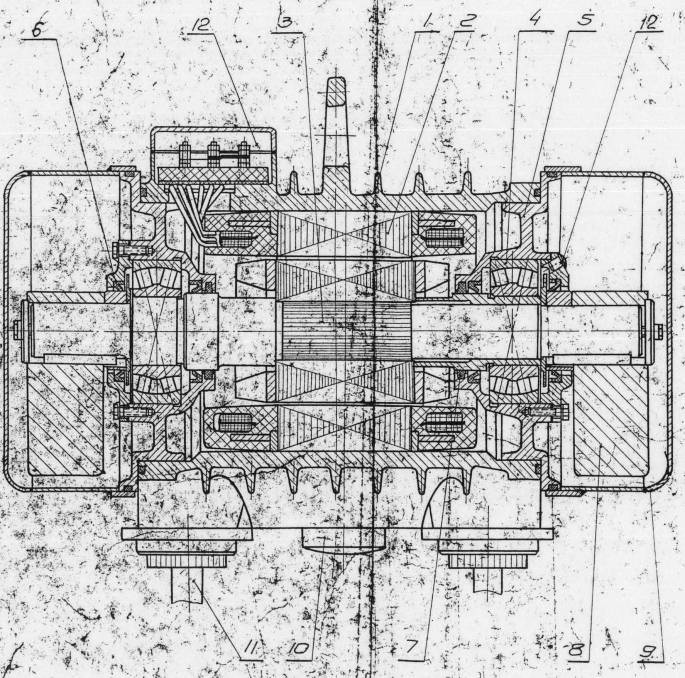
The last of our series on "Checking the Soviets" will deal with the roller bearings for the S-834. Roller bearings, be they spherical or cylindrical, are an important part of vibratory pile driving equipment, although for Vulcan's machines cylindrical bearings were the rule. The bearings (#4 in the diagram above) were GOST 5721-57 3614 bearings. … Continue reading Checking the Soviets: The Life of the Bearings

Checking the Soviets: The Long and The Short of It in Beam Analysis

In the last post Checking the Soviets: Determining the Bending Moment and Stress, and the Parallel Axis Theorem, we looked at a section which was represented to act as a beam. We learned that, if that's true, then the way to reduce stresses isn't just to add material, but to add it judiciously. In this section … Continue reading Checking the Soviets: The Long and The Short of It in Beam Analysis

Checking the Soviets: Determining the Bending Moment and Stress, and the Parallel Axis Theorem

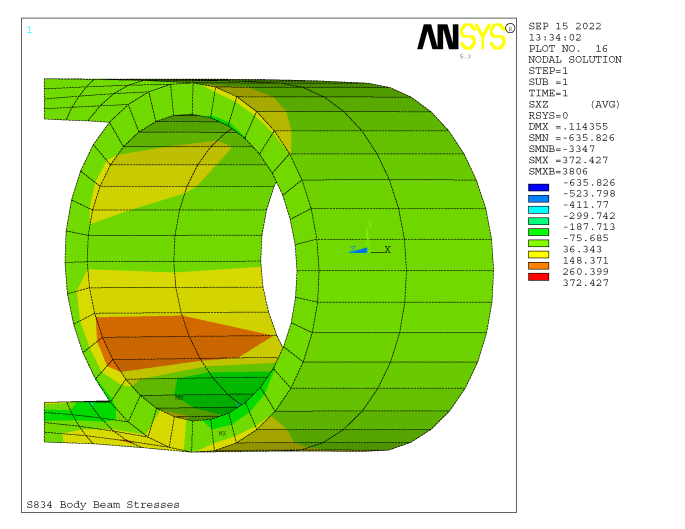
In this section we'll discuss the bending moment of the section which connects the two rotors. It's worth noting that, from a vibratory operational standpoint, the two sets of rotors and eccentrics and self-synchonising, which means that, as they rotate, the amplitude of the vibrations synchronise the rotations. This was applied to vibratory equipment by … Continue reading Checking the Soviets: Determining the Bending Moment and Stress, and the Parallel Axis Theorem

Checking the Soviets: Determining the Bending of the Shaft

In our last post Checking the Soviets: The Strange Case of the Spring Constants we discovered some discrepancies in the design of the springs which, although essentially correct, were hard to explain given the information furnished. In this analysis an entirely different problem is encountered, one which is more familiar to practicing engineers. The problem at … Continue reading Checking the Soviets: Determining the Bending of the Shaft