
The places in the news these days with the war in Iran–Kharg Island, Sharjiah, the Straits of Hormuz and others–bring back memories for those of us who were involved in the “oil patch” and especially the offshore oil patch. And, for those of us who look at this “long view,” it’s surprising that the geopolitics and energy politics of oil in general have changed little considering the half century span between then and now.
“Then” was the late 1970’s, when the oil shocks of 1973–and soon 1979–would make the oil industry very, very busy and tbh profitable. Vulcan already counted Saudi Aramco as a regular customer along with National Petroleum of the United Arab Emirates. For Vulcan Dubai was more than a place for chocolates; it was a stop for its field service personnel.
One project that sticks out is the Yanbu terminal on the Red Sea. It didn’t take a genius to figure out that a) the Straits of Hormuz were easy to close with the right military action or a sunken tanker and b) such a closure would be a disaster for the world energy supply. The Saudis were well aware of both and had both the foresight, geography and resources to do something about it. The result was a pipeline across Saudi Arabia which ended at the Port of Yanbu on the Red Sea and not so far from Mecca and Medina, where Islam got its start.
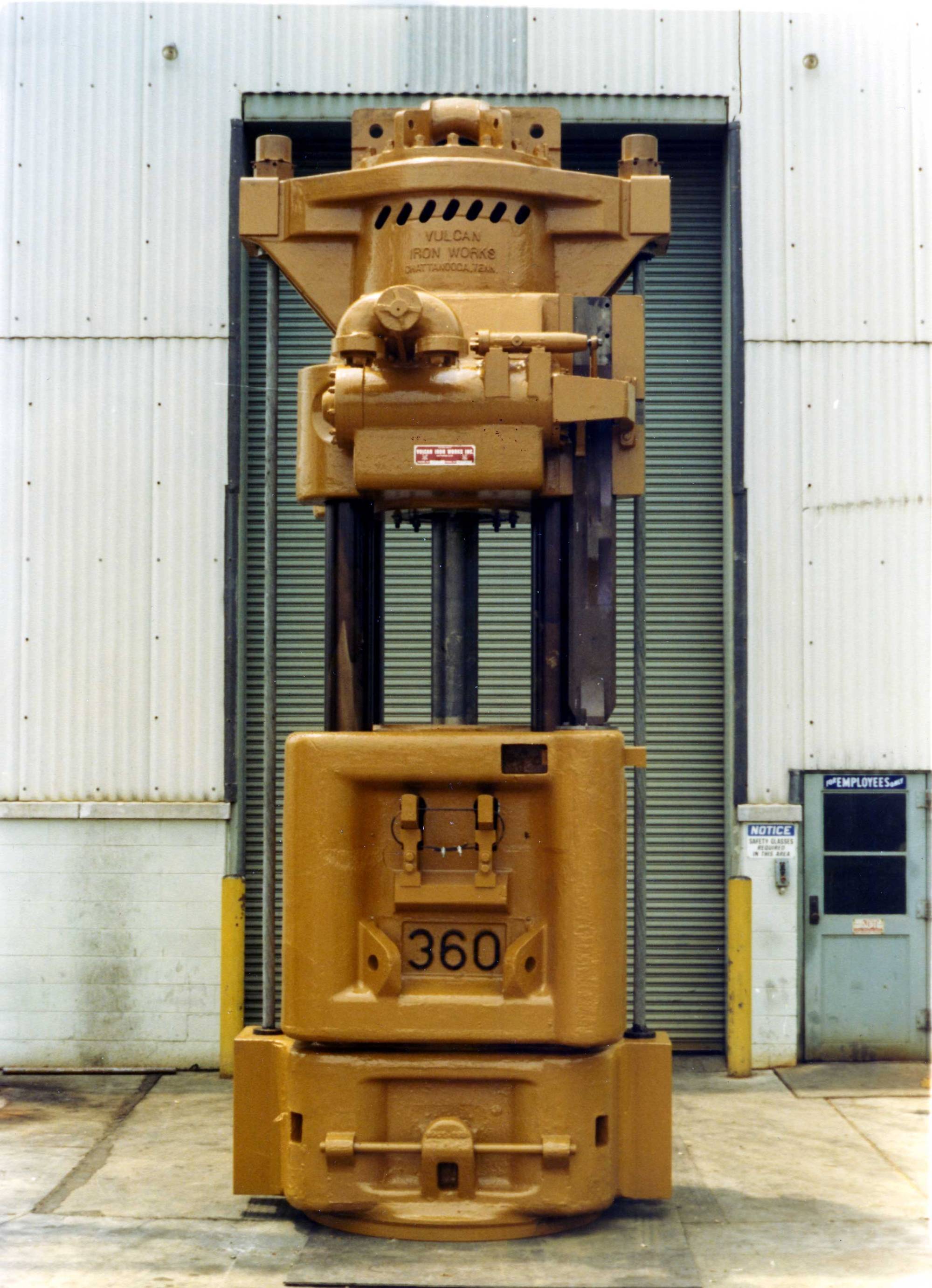
Both pipeline and port had to be built, and for that Aramco turned to Hyundai Heavy Industries (at the time the same company which built the cars) to do the job. Such a port was akin to an offshore oil platform in size and scope, and to install the large steel pipe piles Hyundai turned to Vulcan to furnish the hammers. In 1979 Vulcan sold three to Hyundai: one 020, one 360 and one 560.
It was Vulcan’s first contact with Hyundai, which itself was new in the offshore construction business (at least of this magnitude.) Sometimes it got interesting. Offshore sales manager Herman Hasenkampf would constantly bring up accessories and other items they would need with the hammers. Hyundai’s people tired of these, which led to one of them saying about Herman, “Always causing trouble…”
In any case Vulcan delivered the hammers in November 1979 and more thereafter. The project was completed successfully and is pivotal today in continuing the flow of Saudi oil to the world. The trouble was worth it.
And the Iranians? They too realised the danger of the Straits of Hormuz, and planned to build a port at Chabahar to likewise circumvent this bottleneck. Through its relationship with Brown & Root, Vulcan would have been involved in this project as well. But the Iranian Revolution came in 1979 and the mullahs decided they had other priorities.
At that time and for many years afterward the United States was a net energy importer, something a more forward thinking policy could have avoided. The only reason this changed was because of the development of directional drilling and fracking. The U.S. is experiencing price rises because oil and gas is a global market and what affects one part affects the whole.
After this project Hyundai was a long time Vulcan customer until the end of the Illinois corporation.

 vulcanhammer.info