
When Vulcan introduced the Vari-Cycle in the late 1960’s, it thought that the issue of stroke changing during operation had been solved. But there were exceptions Both the #1 and #0 series hammers had difficulties with physically accommodating the Vari-Cycle, and when the 5′ stroke hammers were introduced in these size ranges there were durability issues.
Conmaco tackled these issues with its own stroke changing device, but ran into problems with Vulcan’s original Vari-Cycle patent. Vulcan for its part eventually developed Vari-Cycle II, which was similar to Conmaco’s, but by then Vulcan’s time was running out.
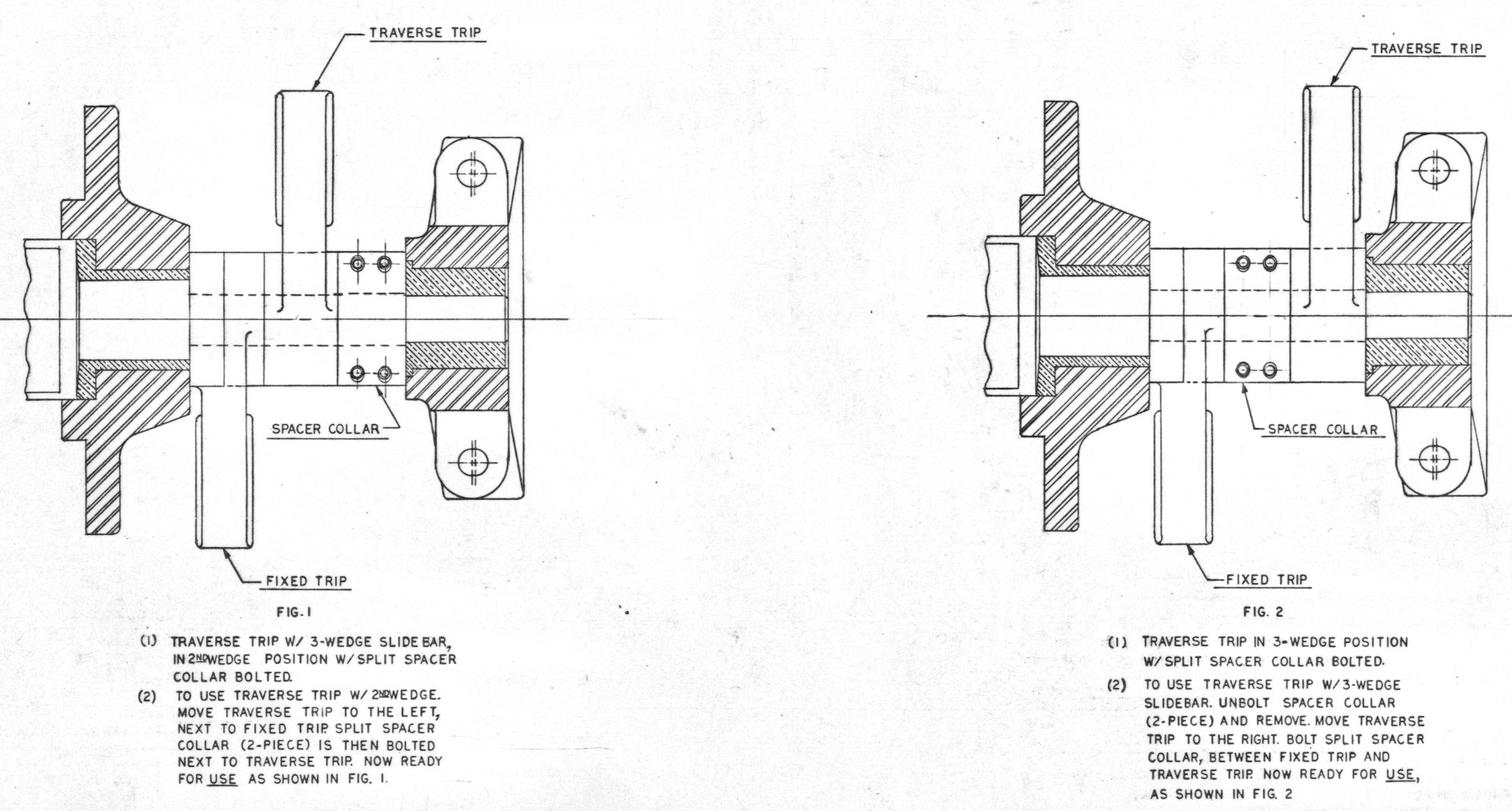
In the midst of all this Vulcan came up with a solution that, while not as automated as the Vari-Cycle, was simple and practical: the traverse trip. As seen in the diagram above, dating from September 1982, it simply involved two “fixed type” trips and a spacer collar. When one wanted to switch from full stroke (Fig. 1) to short stroke (Fig. 2) one removed the spacer collar, shoved the trip over and replaced the collar.
For hammers where short stroking was infrequent–or a short stroke hammer was enough energy for a particular job–the traverse trip was and is a simple, durable and practical way to adjust the stroke on a Vulcan hammer.

 vulcanhammer.info