
In the post Vector Statics and “Old Coot” Statics: An Example, we showed that the reactions for the stiff leg derrick shown below could be computed using either formal vector analysis or what was called the “old coot” method. In this post the member forces will be computed using the “method of joints” (and by that I don’t mean the watering hole the employees went to for lunch or after work.)
Let’s start where we left off by considering the stiff leg derrick as shown below.
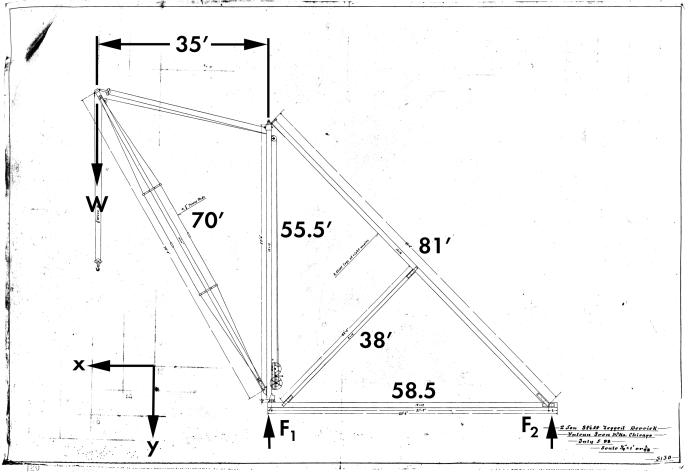
Since it specified as a two-ton derrick, we will assume that W = 4000 lbs. From the previous analysis, F1 = 6392 lbs. and F2 = -2392 lbs. Let’s draw a CAD diagram with a better definition of the geometry and a better designation system for the joints and trusses:

We will assume that, for truss member forces, tension is positive and compression is negative. The simplest joint to start at is Joint 2, the procedure can be outlined as follows:
- Starting at Joint 2, Summation of Forces in y-direction: -2392 + Fb sin(43.5) = 0
- Solving, Fb = 3475 lbs.
- Summation of Forces in x-direction: Fa + Fb cos (43.5) = 0
- Solving, Fa = -2521 lbs.
- Fc is a zero force member so Fc = 0.
- Fd = Fb
- Moving to Joint 1, summation of force in x-direction: Fa – Fg sin(30) = 0
- Solving, Fg = -5041 lbs.
- Summation of forces in y-direction: 6392 + Fe + Fg cos (30) = 0
- Solving, Fe = -2026 lbs.
- Moving to Joint 5, summation of forces in y-direction: -4000 – Fg cos(30) + Ff cos(81.7) = 0
- Solving, Ff = 2535 lbs.
- We can check by looking at static equilibrium around Point 4.
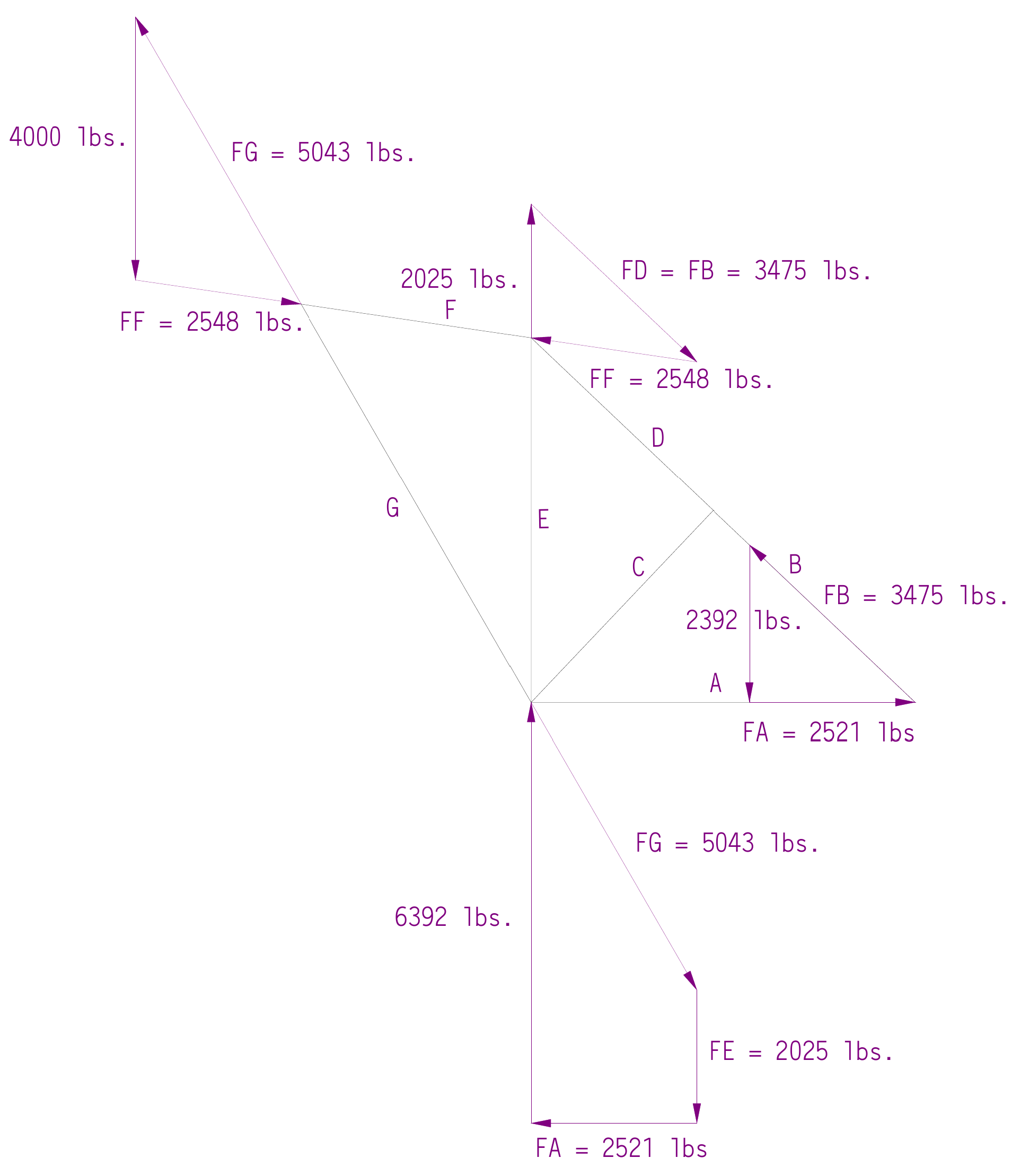
The analysis can also be done graphically. It’s almost a certainty that, back in 1898 when this was drawn up, that’s the way the analysis was done. This is shown below.
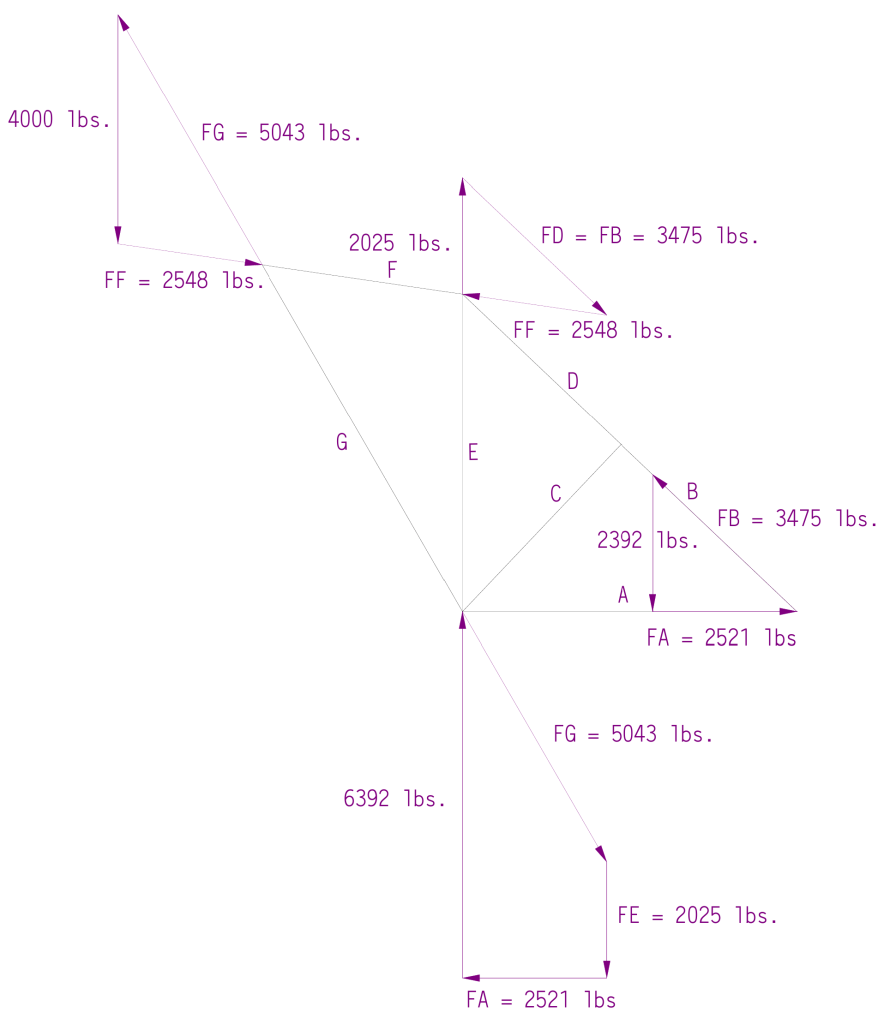
Each joint analysed has a force triangle/polygon (the latter in the case of Joint 1) which is closed. We construct this in the same order as we analysed it above; the force can be copied (and rotated 180 degrees for the opposite end of the truss member) as the analysis proceeds. We can see that the triangle is closed at Joint 4, checking the total result.

 vulcanhammer.info
One thought on “Stiff Leg Derrick Part II: Truss Analysis”