
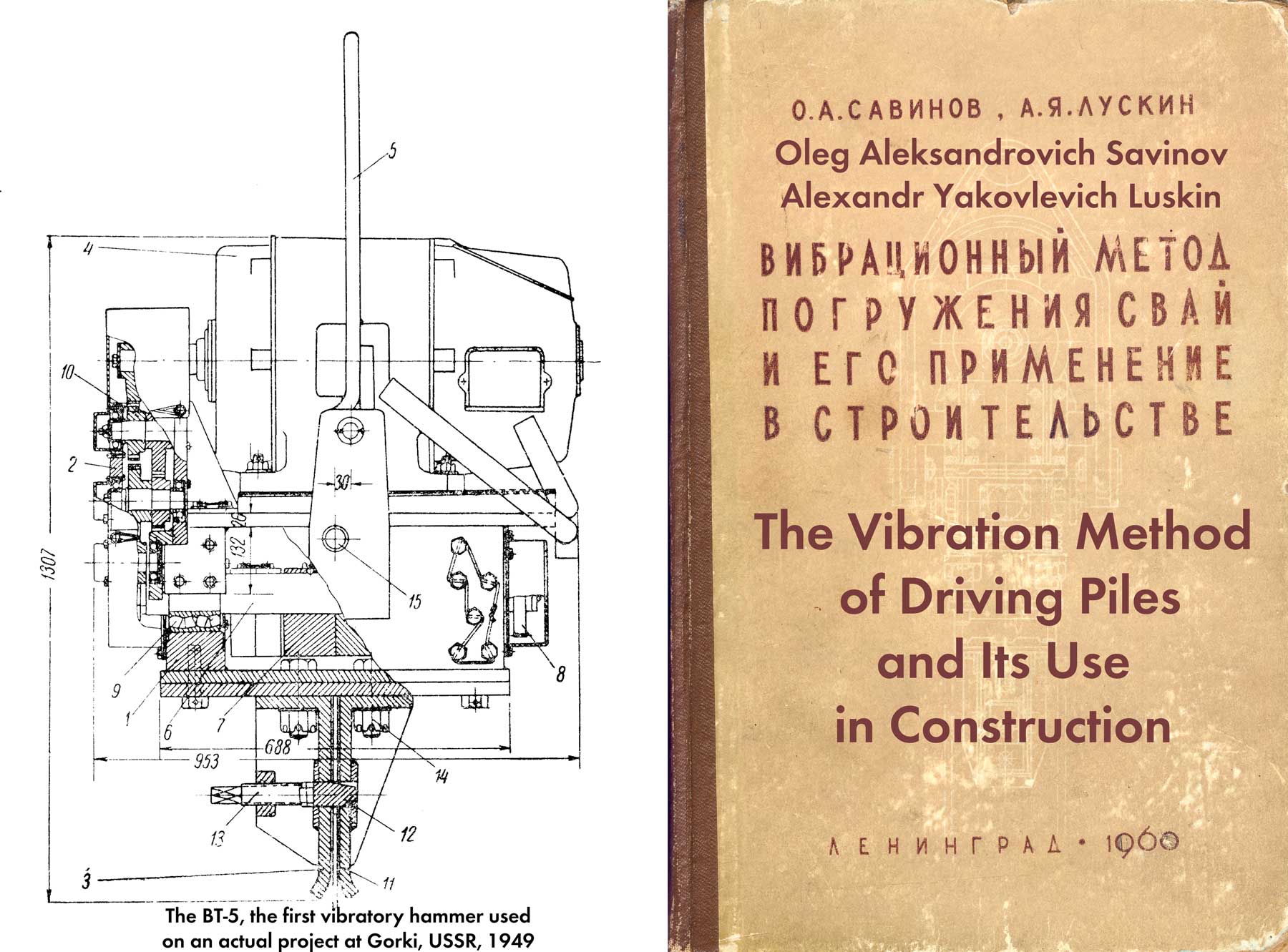
Editor’s Note: this is the original presentation of the “Savinov and Luskin Method” for sizing a vibratory driver for a specific application. It has been reproduced in many publications and in various forms. I would remind my readers that the method is presented here in Those Pesky Kilogram-Force Units.
For successful pile driving in each case it is necessary that:
- the magnitude of the disturbing forces of the vibrator were sufficient to overcome the resistance of the soil to the failure of the pile at a given maximum depth of its immersion;
- the amplitude of the pile vibrations sufficiently exceeded the value of the initial amplitude;
- the value of the resultant of all external forces applied to the pile was sufficient to ensure the required speed of immersion (or extraction) of the pile.
Let us consider each of these conditions separately.
The first condition can be represented as a simple dependence:

Where
– respectively, as before, the moment of the vibrator eccentrics and the angular velocity (frequency) of their rotation;
– the total calculated value of the critical resistance to pile failure at the maximum depth of its immersion;
– some coefficient that approximately takes into account the effect of soil elasticity.
As we have shown earlier, the effect of soil elasticity acts in different ways at different vibration frequencies. For low-frequency vibratory drivers (
The value of
a) for piles

b) for sheeting

Here, the index i denotes the serial number of the soil layer with the thickness 
Thus, the maximum immersion depth is 


In the simplest case, when piles are driven into homogeneous soil, Equations (1.17) and (1.18) take the form:

And

In the second paragraph, we presented some experimental data characterizing the values of 

| Type of Soil | Forces of friction exerted on inserted element. | ||||
For Piles ( ) ) | For Sheeting ( ) ) | ||||
| Wooden piles, steel tubes | Reinforced concrete piles | Reinforced concrete tubular piles, open at the bottom, inserted with excavation of soil | Light profile sheet pile | Heavy profile sheet pile | |
| Water-saturated sandy and slightly plastic clayey soils | 0.6 | 0.7 | 0.5 | 1.2 | 1.4 |
| Same, but with layers of thick clay or gravely soils | 0.8 | 1.0 | 0.7 | 1.7 | 2.0 |
| Only slightly plastic clayey soils | 1.5 | 1.8 | 1.0 | 2.0 | 2.5 |
| Same, semi-hard and hard | 2.5 | 3.0 | 2.0 | 4.0 | 5.0 |
and recommended for selecting the parameters of vibratory pile driversLet us move on to the second condition. Since, as we have shown above, in the case of a complete breakdown of the oscillation amplitude, the piles turn out to be very close to the 

Where
– weight of the pile, vibrator and other parts of the vibrator rigidly connected to the pile;
– required amplitude;
– some dimensionless coefficient taken equal to 0.8 for reinforced concrete piles, and 1 for all others.
So that soil elasticity does not have a significant adverse effect on the pile driving process, the value of

where 
*From the formula, by the way, it is clearly seen that the greater the weight of
The third and last condition can be considered practically fulfilled when:


Where
– weight of the pile, vibrator and additional weights (if any);
– cross-sectional area of the pile;
– required specific pressure on the pile;
– the amplitude of the dynamic force of the vibrator;
– values of coefficients:
- for steel sheet pile –
;
- for light (wooden, tubular steel) piles –
- for heavy (reinforced concrete) piles and wells –
- for steel sheet pile –


For successful pile driving, it is practically sufficient that the value of
Recommended 
| Type of Pile |  | |||||
| Sandy Soils | Clay Soils | |||||
| 300-700 RPM | 800-1000 RPM | 1200-1500 RPM | 400-700 RPM | 800-1200 RPM | 1200-1500 RPM | |
| Steel sheet pile,steel tubes with open end, and other elements with cross-sectional area up to 150 cm2 | – | 8-10 | 4-6 | – | 10-12 | 6-8 |
| Wooden and tubular steel(with closed end) with cross-sectional area up to 800 cm2 | – | 10-12 | 6-8 | – | 12-15 | 8-10 |
| Reinforced concrete,square or rectangular cross section with area up to 2,000 cm2 | 12-15 | – | – | 15-20 | – | – |
| Reinforced concrete tubular piles with large diameter, inserted with excavation of soil from tube cavity | 6-10 | 4-6 | – | 8-12 | 6-10 | – |
| Types and Dimensions of Piles |  |
| Steel sheet pile,steel tubes with open end, and other elements with cross-sectional area up to 150 cm2 | 1.5-3.0 |
| Wooden and tubular steel(with closed end) with cross-sectional area up to 800 cm2 | 4.0-5.0 |
| Reinforced concrete,square or rectangular cross section with area up to 2,000 cm2 | 6.0-8.0 |
The selection of the parameters of the pile vibratory driver must be carried out in the following order:
a) based on the initial data characterizing the soil conditions, using Equation (1.17) or (1.18) and Table 8 to determine the total calculated value 
b) outline the approximate value of the weight

and then according to the formula

calculate the required vibration frequency 
In cases where at first it is not clear in what range the frequency

c) using Table 10, determine the required minimum weight of the vibrator according to the formula (1. 20) and check whether this weight satisfies the condition expressed by the formula (1.21.) If it turns out that the weight obtained by formula (1. 20) 


d) finally set the moment of the eccentrics and the number of revolutions of the vibrator, as well as the weight of the vibrator and, if necessary, additional surcharge, and then check the finally adopted parameters using Equations (1.16), (1.19), (1.20) and (1.21.)
Having the data obtained as a result of the selection of the main parameters of the vibratory driver, it remains to calculate the required engine power and complete the calculation.
The formula for calculating the required engine power is usually given as follows:

Where


‘
The value l:

Where
– diameter of vibrator shaft pins in cm;
– vibrator revolutions per minute;
– coefficient of friction of rolling bearings, reduced to the diameter of the shaft journal; the value can be taken equal to 0.01.
As for other resistances that arise in the vibrator mechanism, the power required to overcome them cannot be accurately determined. It is obvious, however, that these resistances depend on the same factors as the resistances taken into account by Equation (1. 25,) the magnitude of the disturbing force and the number of revolutions of the vibrator. Measurements made by M. G. Tseitlin [61] showed that the power required to overcome friction in bearings and the power required to overcome other resistances in the vibrator mechanism are approximately the same. Thus, in practical calculations, it can be assumed that

The calculation of the coefficient 
E. M. Sinelnikov [55] proposed the following approximate formula for determining the power 

This formula can be used when selecting the parameters of pile vibratory drivers. Taking into account that during its derivation, energy losses due to vibrations of the soil mass were not taken into account, it is advisable in each case to increase the value of 
In conclusion, we give several examples of the selection of parameters for pile vibratory pile drivers for various purposes.
Example 1. Select the parameters of a metal sheet pile vibrator based on the following data: sheet pile type -SHP-I; the maximum depth of immersion in water-filled sandy and weak clay soils with clay or gravel layers is 15 m; the largest weight of one sheet pile (with a length of 20 m) is 1400 kg.
According to tables 8 and 9, we accept:

We accept the weight of the vibrator approximately 700 kg. We find:
a) the value of the total critical resistance to stall:

b) moment of vibrator eccentrics:

c) oscillation frequency:

or

accept

d) determine the required weight of the vibrator.
In this case, condition (1.21) is decisive.
The total weight of the vibratory driver with the pile according to this condition should be equal to: 
Therefore, the weight of the vibrator itself must be at least:

Given that the required weight of the vibrator is 700 kg, the design of the vibrator should include a static load equal to;

Example 2. Check whether it is possible to use a vibratory driver, the parameters of which were selected in the first example, to plunge a steel sheet pile of the Larsen V type (weight 
- 0.0 – 4.0 – water-saturated medium-grained sand;
- 4.0 – 7.5 – fine-grained sand with separate layers of weak clay soil;
- 7.5 – 10 – hard plastic clay soil.
According to the table 8 we accept the values
We determine the total value of the critical stall resistance:

The amplitude of fluctuations of the tongue will be equal to:

Thus, a vibratory hammer with the specified parameters for the conditions under consideration is suitable.
Example 3. Select the parameters of a vibratory driver for reinforced concrete shell piles. Pile dimensions: outer diameter = 1.5 m, wall thickness = 0.1 m, maximum length = 30 m. Weight = 34 t; maximum immersion depth = 25 m, including: in weak clay soils = 10 m, in hard-plastic clays = 15 m. The weight of the vibrator is assumed to be 10 tons.
According to the table 8 we set the values of
We define:
a) the total value of the critical shear resistance, assuming that the height of the unexcavated soil column inside the pile cavity does not exceed 3 m, and assuming 
![T_{kr} = 0.8 \times [(15 + 3) \times 3.14 \times 1.5 \times 1.0 + 10 \times 3.14 \times 1.5 \times 0.5] = 87\,t](https://s0.wp.com/latex.php?latex=T_%7Bkr%7D+%3D+0.8+%5Ctimes+%5B%2815+%2B+3%29+%5Ctimes+3.14+%5Ctimes+1.5+%5Ctimes+1.0+%2B+10+%5Ctimes+3.14+%5Ctimes+1.5+%5Ctimes+0.5%5D+%3D+87%5C%2Ct&bg=ffffff&fg=333333&s=0&c=20201002)
b) the moment of the eccentrics of the vibrator, taking according to Table 9 

c) vibration frequency:

d) the required weight (at the required pressure 

In fact, the weight of the pile and the vibrator is 44 tons; we make an additional check according to the formula (1.21):

The test results are satisfactory.
However, the results obtained should be regarded as indicative. To work in various ground conditions, it is necessary to be able to change the vibration frequency in the range from 

The eccentric moment must be adjustable, and for operation at low frequencies it is desirable to increase it by at least 20%, i.e. bring it up to 40,000 kg-cm,
Example 4. Select the parameters of a vibrator for wooden piles with the following initial data: the maximum depth of the pile = 12 m; the largest diameter of the average cross section = 26 cm; estimated weight = 0.8 tons.
Soils up to a depth of 8 m are water-saturated sandy and weakly plastic clay soils with dense interlayers (

We find the value of the total critical resistance to the failure of the pile:

In this case, it is not yet clear in what frequency range the vibrodriver should operate; so Let us start with the definition of 
We calculate:

We accept 


The required total weight of the machine (for 

Since Equation (1.21) is not satisfied for such a weight 

Checking the correctness of the selected parameters (
The practical method of selecting the parameters of a pile vibratory driver described in this chapter is approximate, but at the same time it gives a fairly correct orientation and allows you to avoid gross errors when choosing the type and parameters of vibratory drivers in relation to certain specific conditions.

 vulcanhammer.info
3 thoughts on “Practical Methods for Selecting the Parameters of a Vibratory Pile Driver”