
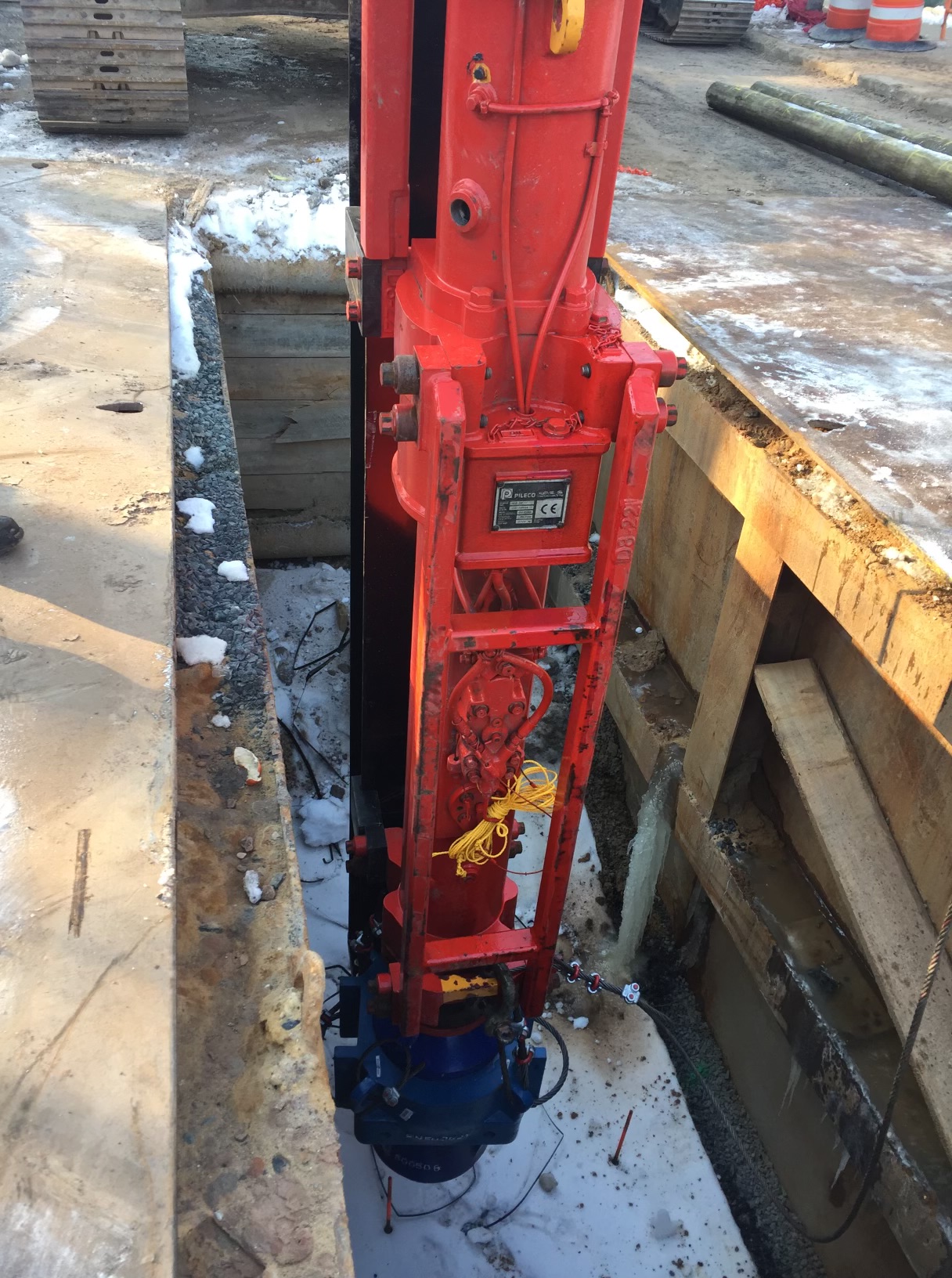
Above: Pileco D-8 diesel hammer on Vulcan Foundation Equipment’s excavator mast, ready to drive below grade. Photo courtesy of Vulcan Foundation Equipment.
Since we dealt with older European diesel hammers in the post Diesel Hammers: Delmag, Nilens and the Method of Analysis, let’s turn to something more contemporary: Pileco diesel hammers, one of several organisations which market the Delmag-derived diesel hammers from China. Conroe-based Pileco has a long history with diesel hammers, having been a Delmag distributor since those hammers were first introduced into the United States. They also led in introducing diesel hammers to the offshore oil industry, where they became a standard for driving oil drilling casing.
We can start by presenting the same analysis for hammers ranging from the D-12 to the D-80 as we had in Diesel Hammers: Delmag, Nilens and the Method of Analysis:
| Model | Pileco D-12-42 | Pileco D19-42 | Pileco D25-22 | Pileco D36-32 | Pileco D-46-32 | Pileco D-62-22 | Pileco D-80-23 |
| Ram mass, kg | 1250 | 1900 | 2500 | 3600 | 4600 | 6200 | 8000 |
| Compression volume, mm3 | 1776360 | 2584240 | 4218030 | 5830520 | 7520020 | 11094000 | 14155100 |
| Ratio of compression volume to ram mass, mm3/kg | 1421.1 | 1360.1 | 1687.2 | 1619.6 | 1634.8 | 1789.4 | 1769.4 |
| Cylinder diameter, mm | 300 | 320 | 419 | 500 | 500 | 550 | 630 |
| Cylinder cross-sectional area, mm2 | 70686 | 80425 | 137885 | 196350 | 196350 | 237583 | 311725 |
| Probable working stroke from GRLWEAP data, mm | 356 | 422.91 | 373.888 | 375.92 | 481.076 | 578.866 | 581.914 |
| Actual expansion volume, mm3 | 26912243 | 36596680 | 55771684 | 79642239 | 101979072 | 148622689 | 195551969 |
| Ratio of Free Air Volume to ram mass, mm3/kg | 21530 | 19261 | 22309 | 22123 | 22169 | 23971 | 24444 |
| Actual compression ratio | 15.2 | 14.2 | 13.2 | 13.7 | 13.6 | 13.4 | 13.8 |
| Maximum Physical Stroke, m | 3.597 | 3.840 | 4.176 | 3.993 | 3.810 | 3.810 | 3.932 |
| Maximum Energy from Maximum Physical Stroke, kJ | 44.1 | 71.6 | 102.4 | 141.0 | 171.9 | 231.7 | 308.6 |
| Actual Working Volume, m3 | 0.0251 | 0.0340 | 0.0516 | 0.0738 | 0.0945 | 0.1375 | 0.1814 |
| Ratio of actual working stroke to cylinder diameter) | 1.19 | 1.32 | 0.89 | 0.75 | 0.96 | 1.05 | 0.92 |
| Initial Pressure (p1), MPa | 0.101 | 0.101 | 0.101 | 0.101 | 0.101 | 0.101 | 0.101 |
| Gas Constant k | 1.25 | 1.25 | 1.25 | 1.25 | 1.25 | 1.25 | 1.25 |
| Compression Pressure (p2), MPa | 3.030 | 2.784 | 2.556 | 2.662 | 2.638 | 2.598 | 2.700 |
| Maximum Combustion Pressure (p3), MPa | 10.86 | 10.86 | 9.31 | 9.83 | 9.83 | 10.00 | 9.72 |
| Ratio of Combustion Pressure to Compression Pressure | 3.58 | 3.90 | 3.64 | 3.69 | 3.73 | 3.85 | 3.60 |
| Total Thermodynamic Energy, kJ | 27.437 | 40.443 | 54.185 | 80.168 | 103.540 | 156.738 | 191.373 |
| Ratio of Thermodynamic Energy to Maximum Stroke Energy | 62.21% | 56.50% | 52.91% | 56.85% | 60.22% | 67.64% | 62.02% |
| Mean Effective Pressure from Energy and Actual Working Volume, kPa | 1091.562 | 1189.069 | 1051.039 | 1086.114 | 1096.141 | 1139.674 | 1054.995 |
Some notes and comments about this result are as follows:
- The data from which this is derived is from the GRLWEAP database. That includes the maximum combustion pressure.
- From higher compression ratios in the smaller hammers, the compression ratio in the larger ones settle down to vary between 13 and 14.
- The gas constant drops from 1.35 (as assumed from WEAP87) to 1.25. This is in line with the Russians‘ assumption all along.
- The initial pressure is assumed to be atmospheric, in accordance with GRLWEAP’s assumption. I think there is merit in the Russians‘ assumption that this will be elevated a little with backpressure during downstroke and blowdown, but I’ve stuck with GRLWEAP’s assumption here. It’s worth noting that, at higher elevations, this will in reality drop.
- The maximum pressures are larger than they were in Diesel Hammers: Delmag, Nilens and the Method of Analysis. There are many possibilities for this, including better measurement techniques, but one factor is that it is possible today to more precisely machine and hone large bores than it was forty years ago, which reduces break-in times and improves the sealing possibilities of the piston rings.
- The mean effective pressures are consistently above 1000 kPa/1 MPa.
- The ratio of thermodynamic energy to maximum stroke (“catch ring”) energy varies between 50% and 70%, which is overall higher than we have seen with any of the hammers we have analysed.
The impression for this data shows a technology that has improved over time.

 vulcanhammer.info
One thought on “Diesel Hammers: Pileco”