
MORE RESOURCES
- Foundation Design and Analysis: Deep Foundations, Pile Dynamics
- Design and Construction of Driven Pile Foundations, 2016 Edition. The second volume covers this topic.
It should be obvious that the state of our predictive methods should make verification necessary for deep foundations, and that is certainly the case. One type of verification already discussed is Static Load Testing; here we will consider dynamic methods.
Case Damping Method
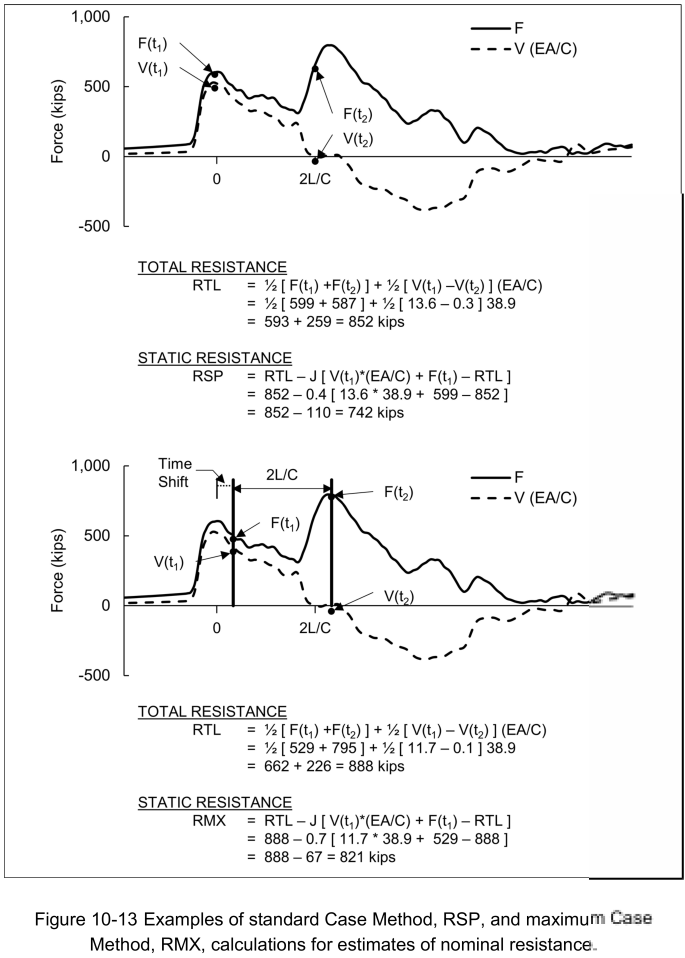
One early (1960’s) attempt at estimating the capacity of a pile from dynamic measurements was the Case Damping Method. I discuss this with a worked example in the post The Case Method: An Overview and Worked Example and will not discuss it here further.
CAPWAP and Inverse Methods
This is a complex topic that has kicked up a fair amount of discussion since its formal introduction in the early 1970’s (although work started on it in the late 1950’s.) The basic idea is that we start by instrumenting the pile at the head with strain gauges and accelerometers. With some processing we end up with two things: a force-time (and stress-time) history and a velocity-time history. We use these and, by the progressive application of what amounts to an optimisation/signal matching technique, end up with a distribution of resistance along the shaft and at the toe of the pile. This process is shown graphically below.
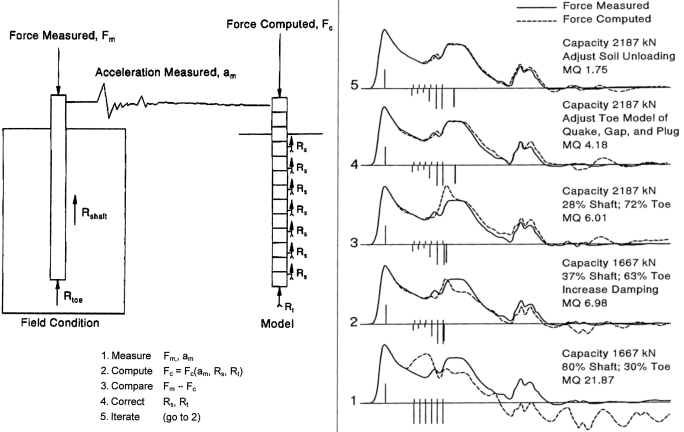
A fairly detailed discussion on CAPWAP–and the whole use of inverse methods of one kind or another in pile dynamics–is contained in Improved Methods for Forward and Inverse Solution of the Wave Equation for Piles.
Statnamic Methods
These were developed in Canada and they fall somewhere between high-strain dynamic methods and static load testing. They are discussed in detail at the end of Foundation Design and Analysis: Deep Foundations, Pile Dynamics and will not be considered further here. An example of a Statnamic test in action is shown below.

 vulcanhammer.info
2 thoughts on “Driven Pile Design: Inverse and Verification Methods”